Monday, June 22, 2015

Body and Soul


Six months into my biography project. If you’re new, or just not paying attention, I have decided to dedicate this year to the study of biographies (and autobiographies) or musicians and dancers. Why musicians and dancers? The simplest answer is these are the two topics that have always kept my full attention. Ballet, specifically, fascinates me with its aesthetic, grace, precision, and discipline. The finest dancers possess strength, musicality and astounding control. 

I was fortunate to study ballet while pursuing a dance minor at college. I enjoyed the jazz and modern classes, but always took more ballet classes than was strictly necessary. The feeling of executing a perfect pirouette or moving through an extended adagio combination without losing your balance is absolutely thrilling. I managed to progress enough to try some work en pointe, which is every bit as challenging as it appears to be. After a nearly 10 year lay-off, I have finally returned to a ballet studio. It is so difficult, but I love every minute of it.

At the end of last year I read Apollo’s Angels: A History of Ballet, by Jennifer Homans. This well-researched book chronicles ballet through its beginning in 17th century France, its move through Italy, its subsequent grip on Russia, all before launching itself upon the world. Because so much of the history of ballet is tied to aristocracy and politics, I wound up learning more about European history than I ever did in history class. 

My biographies started with the sublime Dame Margot Fonteyn and has, up to now, taken me through the lives of Maria Tallchief, Jacques D’Amboise, Suzanne Farrell, George Balanchine, and Gelsey Kirkland (whose autobiography I have now read three times). Not surprisingly, they all dance through each others’ books, as they ballet world is rather small. The composers who write through this world include Stravinsky, Tchaikovsky, Chopin, Debussy, among many others.

The musician side of this project is, for better or for worse, heavily weighted in the jazz genre. My jazz foundation began when I was a kid, just starting to notice this thing called jazz. One of my first long reports in school was one of the history of jazz (I also did a report on the history of ballet). I learned about jazz’s beginnings in New Orleans (the history of which is only just now beginning to be clarified) and how it made its way to Chicago and Kansas City and then to New York as it spread itself throughout the nation and the world. Since that initial research, and forevermore, New Orleans has held a special place in my heart as the birthplace of such an intriguing art form. So perhaps it may have been a bit cloying to start the musician side of this project with Terry Teachout’s Pops. Considering Louis Armstrong’s influence on so many musicians since he picked up a horn, it just made sense to me to start the project this way. Following Louis, I have read my way through the lives (and times) of Artie Shaw, Lawrence Welk, Benny Goodman, Charlie Parker, and Woody Herman.

Biographies are brilliant ways to learn history, as no one lives in a vacuum. I have also found them to be a great source of inspiration. The great musicians and dancers are great for a reason. They have talent, certainly, but they also possess ideas, grit, determination, and absolute dedication to their craft. These are qualities that should be acknowledged, admired, and held up as an example of what an individual can accomplish.

Looking forward to the rest of the year, I notice that female musicians are under-represented, so I will be on the lookout for some good women. In the stack of books, though, are the lives of Vaslav Nijinsky, Bob Fosse, Miles Davis, Count Basie, Dizzy Gillespie, the Dorsey brothers, and Lionel Hampton. 

Now if you’ll excuse me, I have some reading to do.

Friday, July 4, 2014

In the middle of the pouring rain.


Walking in Memphis was written by Marc Cohn and was released in 1991.  Cohn wrote the song after a visit to Memphis, TN.  It is semi-autobiographical and takes the listener on a trip through history and nostalgia.

He first mentions putting on his blue suede shoes, a tribute to Carl Perkins who recorded the song Blue Suede Shoes for Sam Phillips at Sun Studios.  Sun Studios is also located at 706 Union Avenue, as mentioned in the lyrics, and is where Elvis, Carl Perkins, Johnny Cash, Jerry Lee Lewis, and countless Delta bluesmen recorded their music in the hopes of hitting it big.  He touches "down in the land of the Delta blues": Memphis is the top corner of the Mississippi Delta region; "in the middle of the pouring rain": the piano melody that opens the song is reminiscent of falling rain.

W. C. Handy is also given a mention, and justly so.  While Handy wasn't a Delta bluesman (he was actually a formally trained musician and bandleader), he was one of the first to recognize the brilliance of blues music.  It was Handy who introduced the blues to the rest of the world (before the recording studios took the chance).

Cohn sees the ghost of Elvis on Union Avenue, then follows "him up to the gates of Graceland", Elvis's Memphis mansion.  Inside a "pretty little thing" waits for the King in his Jungle room (Elvis' homage to his favorite vacation spot, Hawaii).

While he was in Memphis, Cohn took a short drive out of town to visit The Hollywood Cafe, which is a real place off of Highway 61.  Murial, who "plays piano every night at the Hollywood" struck up a friendship with Cohn and even attended his wedding in New York.  She was immortalized by being written into the song.

"Catfish on the table and gospel in the air" reminds us that we are truly in the South.  "Reverend Green be glad to see you" tributes Al Green, who is a celebrated soul singer in his own right, and later became an ordained pastor for the Full Gospel Tabernacle in Memphis.

Tuesday, July 1, 2014

Do you hear the people sing? Again?


I recently played in the pit orchestra of a production of Les Miserables, (or Les Mis to the initiated).  It is a musical that adapts Victor Hugo's epic depressing story of poverty, desperation, revolution, and ultimately, reconciliation and hope.  My part in this production is to cover the Reed 3 book, which asks for Eb clarinet, Bb clarinet, bass clarinet, and tenor recorder.  See family portrait, above.

The musical was initially not well received when it opened on Broadway in October of 1985.  Now, however, it is one of the most beloved musicals in the Broadway (and off-Broadway) canon.  Listening to the musical repeatedly, as is the case when playing in pits, one starts to observe.  For example, the "On My Own" theme is used throughout, and because the musical is sung-through (using recitative, much like an opera), several sing-speech motifs come through.  The first motif of this style is given when the farmer dismisses Jean Valjean from his work. "You'll have to go. I'll pay you off for the day. Collect your bits and pieces there and be on your way."  The same motif returns when Valjean is again asked to leave the doorstep of an inn he wishes to stay in.  "Our rooms are full."  Later, we hear the same motif from Madame Thenardier is yelling at young Cosette to draw some water from the well.  Similarly, the "Empty Chairs and Empty Tables" melody is first heard from the Bishop at the beginning of the musical when he is trying to help and console Valjean.

This style of composition is called leitmotif, which means to repeatedly use a short phrase or musical idea throughout an entire work.  Leitmotiv comes from the German that means "guiding motif", and one of the first composers to really make great use of it was Richard Wagner in his operas (though he did not invent leitmotifs).  Often, leitmotifs are used to signal the arrival of a character, as heard in Hector Berlioz's Symphonie Fantastique.  The Fantastique is a portrayal of a series of dreams of a lovesick artist.  The leitmotif that drifts around the work is a representation of an unattainable woman the artist loves.  In the March to the Scaffold movement, our tortured artist drugs himself with opium and has horrible visions, which include him being marched off to death for murdering his beloved mystery woman.  Just before the guillotine falls, the artist thinks of his beloved, the theme soars (this time from a clarinet)...and is cut short at the drop of the blade.  We hear his head bouncing down the steps, and the attendant crowd cheers. 

Times were different then.

Tuesday, May 27, 2014

Moo

Lest you think I will never post again, here is a picture of a group of musical barnyard friends.


The fellow on the saxophone could really wail.

Monday, March 24, 2014

NASA Day 3

Whoa!  What a weekend! 

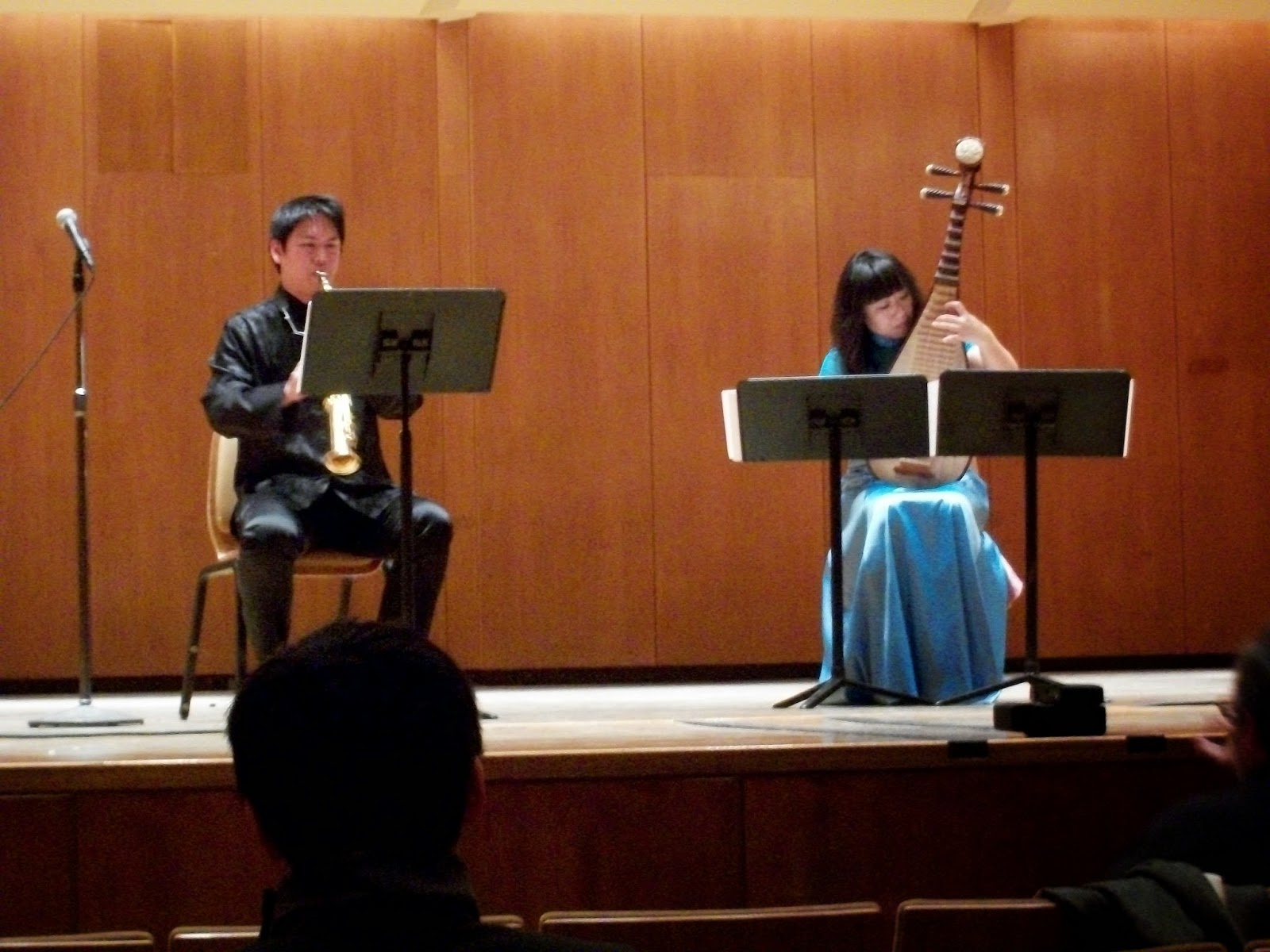
Sunday, Day 3, for me began softly, with a lovely pair of duets with soprano saxophone and an instrument called the pipa (pronounced peep-a).


The young man on the saxophone had a beautiful, clear tone.  The pipa player was fascinating to watch.  A pipa is a four-stringed instrument from China that sounds like something between a mandolin and a lute, being strummed and plucked.

Second on the program for this early recital was an alto player with didgeridoo.  Time to wake up, I guess!  The man playing didgeridoo sounded great (I've always loved the sound of a didgeridoo) and was a remarkable accompaniment to the sax.


For the last piece, the didg player laid down the traditional instrument and picked up an odd arrangement of pipes.  He called it his "sewer sax", being made of sewer pipes.  It is played like the didgeridoo, but has an extra pipe end that can be covered with his hand to create two different pitches.  Thus, his new instrument can do more than just drone on one note.  Outstanding!

Following the recital was a NASA General Membership meeting.  Old and new business was discussed.  NASA, as an organization, isn't as old as I thought it was, and membership is growing.

Then, Eugene Rousseau lead a masterclass.  Here he is, imparting wisdom:

 
After the masterclass, my mouthpiece and I took another spin through the exhibit hall to try out the Bauhaus saxophones.  Bauhaus is a company out of the United Kingdom that focuses solely on saxophones and is starting to distribute in the U.S.  They play very nicely, though are a bit heavy (which translates to better sound, ultimately).

By the time this ended, I was badly in need of some quiet time.  The third day of many of these conferences and conventions can sometimes feel like burn-out, despite your interest and love of the subject matter.  So, I took myself and a book over to the corner coffee house to get in some reading and relaxing.  It was my mini-vacation, after all.

Relaxed and well-read, I then headed back to the lecture hall.  I took in a performance of a piece for tenor sax and percussion, ably performed by an old friend from way back.  Then grabbed the last portion of a performance lecture on the saxophone life and times of 1920s musician Kathryn Thompson.  A woman of the jazz age, who reportedly strongly disliked jazz but wrote some sparkling ragtime music for saxophone and taught saxophone in a music school in southern California. 

The final two lectures I attended dealt with building up a private lesson studio and teaching critical thinking to students.  With these ideas and thoughts rattling around in my overwhelmed, slightly sleep-deprived brain, I strolled back to the car and headed for home.


Saturday, March 22, 2014

NASA Day 2

What a day!  Got up early to get back to campus to start the day with a lecture on Alexander technique.

But before I could do that, I had to wait for the geese to cross the road in front of my hotel.


Okay, Alexander technique.  I thought this method was only for actors, but many of the concepts can be applied to any discipline, including playing an instrument.  It is more than posture and deals more with balance, "non-doing", letting go of tension, body kinesthetics, and awareness.  It requires recognizing a bad habit and replacing it with a better habit.  With the saxophone, much can be done just by adjusting the neckstrap to a place where the weight of the horn is less severe on your neck body alignment.

Following the Alexander lecture was a presentation by Pedrosaxo.  www.pedrosaxo.com if you are interested.  He was "discovered" by Jeff Coffin, who persuaded NASA to feature him at this year's conference.  "Break your limits" to quote Pedro, and he broke limits.  His music creates soundtracks and sonic landscapes without overdub or electronic assistance (except for maybe a bit of resonance through his computer).  His music is personal, emotional, and impressively performed.  For his presentation he performed four pieces, one of which was played without the mouthpiece and another played on just the mouthpiece and neck of the horn.  Not just sax tricks though, he used throat singing, multi-phonics, and singing and playing simultaneously.


Pedrosaxo


Mind blown, I headed over to hear a panel discussion about the history of classical saxophone pedagogy.  Members of the panel were none other than Fred Hemke, Steve Mauk, and Eugene Rousseau. 

Over lunch I listened to some fine student sax quartets and took a spin through the exhibit hall.  I was excited to find some publications of music of Rudy Weidoeft (that I can't wait to get home and try out!) and a book of Bach music transcribed for saxophone.  I also took the opportunity to try out the new Keilwerth MKX.  Not only is it a beautiful horn, it plays great.  So great, I didn't really want to put it down.  Always a good sign of a quality instrument.  I also tried a couple of the new model Buffet saxes.  Not as much to my preferences, but built well.  I noticed that the finishes really made a big difference with these horns.

After the test drive and shopping session, I wandered back over to the lecture hall to hear a talk that really boiled down to fundamentals as they relate to classical style versus jazz style.  It was just the kind of nit-picky, lazer-beamed, hyper-focused lecture that academics are known for.  But I still managed to pick up some information that may be useful with my students.

The evening concert was a superb showcase of ensemble and chamber work featuring saxophones.  A duet with piano, a quartet, saxophone with percussion ensemble, the Moanin' Frogs sax ensemble, the Eastman Saxophone Project, and Jeff Coffin and Futureman returned to the stage.  Bravo!

And thus concludes day 2: chicken soup for the saxophone soul.

Jazz on Stage 5

Oh yeah.  Doxy.

NASA-ers

Friday, March 21, 2014

NASA Day 1


Woke up bright and early this morning to hit the road to attend the 2014 North American Saxophone Alliance (NASA--clever, eh?) Conference.  Which is a bit of a mouthful, so from now on, I will refer to it as Saxfest. This is my first Saxfest and I hope to get recharged (it is sort of a mini-vacation for me), pick up some inspiration, learn new things, and hear some good saxophoning.

After arriving at the campus of the University of Illinois and securing a parking permit (no sense feeding meters all day when a day pass can be procured), I headed to the Krannert Center for the Performing Arts to check-in and see what's what. 

The first thing I encountered was and ensemble showcase of the UMKC Conservatory.  It was lovely sounding entrance music as I got  checked in, met up with a couple fellow QCA friends, and refueled my coffee cup.

After coffee and reviewing the day's schedule, my friends and I took a look at the saxophones exhibit.  Here we found some vintage copy from saxophone ads for Conn, Beuscher, and Selmer companies.  Also available for perusal was a collection of saxophones from the era of the man himself: Adolphe Sax.


Also on hand was this Grafton plastic saxophone.  Charlie Parker used a horn like this we he hawked his good horn for drug money. 
Bass saxophone. Don't see these everyday.  Well, unless you own  one.

Then it was off to the Music Building for a recital of new music for saxophone.  The building is rather extraordinary.  My pictures don't do it justice, considering my camera is getting a bit dated (so much so that the last photo kiosk I took it to to print pictures told me that the resolution was too low.  Cheeky kiosk.)

The program for this recital featured music written within the last several years.  The last piece on the program was a world premier composed by Dorothy Chang, who was in the audience to talk about her piece.  New Stories for Alto Saxophone and Piano was performed by Joe Luloff and showed how versatile the instrument can be in conveying mood and imaginative landscapes.

After the recital, I wandered into a lecture about Bessie Mecklem .  Bessie was one of the first female saxophone soloists who had an active performance schedule in New York.  She recorded some with Thomas Edison, but unfortunately, the recordings have been lost.  What was most interesting takeaway from this lecture was the prevailing attitude towards woman musicians, particularly woodwind players, at the Turn of the Century.

Not really wanting to go too far from the lecture hall because I wanted a good seat for the Jeff Coffin clinic, I stuck around for the following discussion panel.

The panel discussion, titled "D.M.A or J.O.B. Pathways to Employment in the Academy and Beyond" was interesting to listen in on.  Even though I don't have current aspirations to get a DMA or to make a run for the very few jobs available in academia, I did find some inspiration in the advice given from the panelists. 

From my notes: "What do people hope to gain from their musical experiences?" and "What does it mean to be a teacher?"  Some interesting questions to consider.

Just after the panel discussion was the Jeff Coffin clinic.  Jeff Coffin on saxophones and Roy "Futureman" Wooten on drums.  They began with about 35 minutes of non-stop jazz interplay made up on the spot.  Both are entertaining performers, playing with tone color, sound effects, water bottles, and comic devices all without dropping a beat.  Coffin then asked us to list all of the things we heard. 

The listening exercise spun out into a discussion of the Five Fundamentals.

Coffin lists these fundamentals, in order of importance, as:
1. LISTENING (all caps because it is very important and required before the others can make any sense)
2. Tone/Dynamics (including emotional dynamics)
3. Harmony--This is a huge topic, so start small and start to connect the dots.
4. Rhythm/Time
5. Articulation --This can be an extraordinary expressive device.

With practice and mastery of these fundamentals, your opportunities for expression as a musician can increase dramatically.

An inspiring and energizing first day at Saxfest!

Wednesday, March 19, 2014

The Circle Part 2

Last time we took a closer look at the Circle of Fifths.

Here it is:


Sharp keys are found on the right side, reading around clockwise.  Flat keys are found on the left side, reading counter-clockwise.  Sharps and flats are added one at a time, and in always the same order, when keys are viewed in intervals of Fifths or Fourths (reading to the right or left, respectively).  The order that these sharps and flats are added are consistent and also present a pattern.  Sharps are added to progressive key signatures in this order:

                                 F  C  G  D  A  E  B

So, G major has one sharp, and it is F#.  D major has two sharps, and they are F# and C#.  A major has three sharps: F#, C#, and G#.  And so on around the Fifths side of the circle.

If you read around the keys on the left side, you will read in a progression of Fourths.  Flats are added in a consistent pattern also.  F major has one flat: Bb.  Bb major has two flats: Bb and Eb.  Eb major has three flats: Bb, Eb, Ab.  Let's look at the pattern that emerges from the order of the way the flats are added:

                                 B  E  A  D  G  C  F

Compare that to the order of sharps.  It is the sharps order in reverse!  Way cool!

Now, let's say that you only have access to a Circle with key names (it doesn't show you the signatures).  What are you going to do?  Well, the first answer is that you are such a well-prepared musician that you have the keys memorized (which you should strive for) but failing that, you can just memorize three key signatures and figure out the rest using the Circle. 

The three to memorize: C major has no flats and no sharps.  Every tone in this scale is in its natural form.


                                    G major has one sharp.  That sharp is always F#.
                                    F major has one flat.  That flat is always Bb.


Now the trick using the Circle: Sharps and flats are always added in a consistent and predictable order.  If you need to figure out D major's key signature you would recall that F is added first....uh oh! Then what?! Look at the Circle.  Locate F.  Then read around clockwise. There is the order of sharps!  F C G D A E B 
So, D major would have F and C sharps. 


What about flats?  Recall that Bb is the first flat added, then it adds flats in the reverse order of sharps.  But if that is too much work, locate Bb on the Circle and read around counter-clockwise. There is the order of flats! Bb Eb Ab Db Gb Cb (Fb)


TAA DAAAAA!!
Who says music theory has to be boring?! 

Sunday, March 16, 2014

The Circle Part 1


This is the Circle of Fifths.  From now on referred to as "The Circle".  The Circle (sometimes known as the "cycle", is super handy for those who are still a bit fuzzy in the ways of keys and key signatures.  At first glance, we see that it represents the key signatures arranged in a way that they increase in sharps or flats as one reads around in either direction.  We also see that both major and minor keys are represented.  What you may not see at first glance is all of the patterns.  Let's take a closer look.

Prerequisite knowledge: a key signature is the shorthand representation of the notes that need to be altered from their natural tones throughout a piece of music to play in the proper key.  The key signature remains in effect throughout the entire piece or until it is changed with another key signature.  Accidentals (a flat, sharp, or natural sign written into the music) can alter the effect of the key signature, but are only valid through the measure in which they are written.

The first pattern can be found in the sharps themselves.  The last sharp added to any major key is one half-step lower than the key name.  In the key of D major, for example, the last sharp added is C#.  C# is a half-step lower than D.  A# is the last sharp added in the key of B, and so on.

On the flat side, the last flat added is the key's fourth scale degree.  So, for example, in the key of Bb the fourth scale degree is Eb, which the last flat added to the signature. You can see this for yourself if you write out the scale and counting the scale degrees, starting with the key name note labelled as 1:

                          Bb       C       D      Eb      F      G      A      Bb
                            1         2       3       4        5       6      7     1 (8)

There's more awesomeness within the Circle.  Check back for Part 2!

Saturday, January 25, 2014

Well, okay then

So, I had the thought of researching what instruments well known composers played as children, before they began composing.

Well, this isn't very interesting now, because after just a short search into the early years of Bernstein, Mozart, Beethoven and a few others, I now know that most of them played keyboard instruments or the piano. Except for Franz Joseph Haydn, who also played violin and sang as a young composer-in-training.  In addition to the harpsichord. The harpsichord is a keyboard instrument. Of course. 

And that is that.


:-/

Sunday, January 12, 2014

Megacolon

Like any good zombie, MusicZombie is undead.  It may hibernate from time to time, run down and tired from lack of good brainy nutrition, but it will always reanimate in search of its food source.  Unless it gets a bullet in its own brain, of course.

So, back again, on a semi-even food-intake level.  This time found in the latest book from one of my favorite authors, Mary Roach.  I have read every book she's written, which include topics about spaceflight to Mars, death, and the physiology of sex.  Her latest is a trip through the alimentary canal (that's the food tube, to those of you who lack dictionaries).  Gulp takes the reader through the digestive system, starting with the nose and saliva and ending at the rectum.  Not topics that may arouse a drowsy MusicZombie...until the entry into the small intestine and colon, where Mrs. Roach explores what really killed Elvis Presley.

It is common knowledge (I think) that Elvis died in the bathroom, apparently straining and causing cardiac arrest.  What is not commonly known is that he possibly suffered from a disorder called Hirschsprung's disease (though without a complete medical history from birth, it may be impossible to know for certain).  Basically, this means that while still in embryonic development (in the womb, again for the dictionary-less among you), the nerve tracks that are being laid throughout the soon-to-be digestive tract fail to develop throughout the entire length of the food tube.  The end of the line is left without the nerves that direct peristalsis (the wave motion that pushes foodstuffs through the intestines).  As a result of this defect, fecal matter gets stuck, so to speak, and gets backed up.  The unfortunate soul with this condition must then rely on sheer mass of stuff coming in to push old stuff to forward.

So, Elvis had to deal with a wicked bout of constipation nearly his entire life.  Drug use, no doubt, complicated the condition.  This actually may help to shed some insight on Elvis's appearance in his later years.  His stretched out, overly packed "megacolon" can be offered for his larger physique, and reports of lackluster concerts.  His autopsy also showed an overly packed, grossly large colon.

And with that, we begin 2014 with MusicZombie!

Thursday, October 10, 2013

Curiouser and curiouser...


Sure, it has a flute-like headjoint, but that key work is all clarinet.
Nice try, House on the Rock!

Wednesday, July 31, 2013

Cornet


Bix Beiderbecke's cornet.
You can see it for yourself when you visit the Putnam Museum in Davenport, IA.

The Bix7 roadrace was this past weekend.  This weekend, the Bix Jazz Festival will take over Davenport.  

Jazz on, my friends.  Jazz on.

Monday, July 29, 2013

You read it here first! Probably.

Interview with a Bass Flute

A Music Zombie Exclusive!


Recently, Music Zombie had the chance to meet a Bass Flute.  After some bargaining, and maybe just a little bit of blackmail, the Bass agreed to an interview.  What follows is the transcript of that interview.


Music Zombie:  Thank you so much for agreeing to speak with me.  It's not everyday that I get the chance to meet such an unusual instrument.

Bass Flute:  Well, I am not that unusual.  But I suppose that I don't make as many appearances in bands and orchestras as my higher-pitched relatives.  They like to be heard, I guess.  I prefer to just support the low end of the section.  Occasionally, I will take solos, but because I am hard to hear at times, I often need extra amplification from those nerdy sound-crew people.  And, well, you know how they can be...they're all "Can you move closer to the microphone?"-this and "can you play any louder?"-that.  Sheesh...

MZ:  Still, you make an interesting sound.  You really add something extra to flute choirs.  More depth to the sound, certainly.

BF:  I suppose.  Did you know that I read the same music as C flutes, but the sound I produce is a full octave lower?  Sort of the opposite direction that a piccolo will take.  You know those piccolos like to shriek above the music a full octave higher than the flute.  Haha!  Squeaky little things!

MZ:  Isn't it true, though, that you share some things in common with the piccolo, in terms of construction?

BF:  Well, yes.  Oftentimes, we are made without the extra keys as the foot joint (or completely missing the foot joint, as in the piccolo's case) and I lack trill keys.  I don't suppose folks have any interest in hearing basses trill. 


MZ:  Say, what is the funny foot thing you've got there near your left hand key section?

BF:  My crutch?  Well, I'm glad you noticed! Because my tube is so large, and I am quite a bit heavier than the small flutes, this crutch allows my player a more comfortable hand position.  Here, give it a try.  You will notice that it feels more stable when your left hand has more support.


MZ:  You're right!  That feels pretty comfy!  I did notice that your keys aren't really that much farther apart than on a regular flute, but the hands are more spaced apart. That means that your tube is much longer than a regular flute...but that is to be expected for a low-sounding instrument...care to elaborate?


BF:   Exactly!  Longer tubes equal lower tones.  Again, compare me to the high-sounding, short-tubed piccolo!  However, because my tube is so long, my head joint is usually built with a crook in it.  This brings the hand closer to the player.  This wasn't always the case.  The great instrument designer, Theobald Boehm, made a straight model.  It is reported to have great tone and power, but is really hard to hang on to while playing.  So, most of us nowadays are given curves.


MZ:  Fascinating!  One more thing I couldn't help but notice--your lip plate has a wall on it!  Tell me about that!

BF:  Oh that?  That little wall on my embouchure plate makes me a bit easier to produce a reliable tone.  Because flute players need to create their own back pressure, and I require so much air to play, adding a bit of built in resistance makes me speak better.  What can I say?  I guess I like to play hard-to-get!

MZ:  Well, thank you so much for agreeing to speak with me!  My readers will be delighted to hear what you had to say, and you've certainly taught me a lot!


BF:  You're welcome, I guess.  I guess I'll go back to my case now and take a nap.  Please, no more pictures.

"I SAID NO MORE PICTURES!!"

Sunday, July 28, 2013

DMB at Alpine Valley, WI 2013

Here are a few pictures from the Dave Matthews Band concert my friend and I attended at Alpine Valley in Wisconsin.  The concert was part of a two-night stand at the venue (common for this band).  We attended the July 6 show.  It was awesome!


We went kayaking in Madison before heading over to Alpine Valley.  Super fun!


 The venue.  You can see the ski slopes in the background


Pre-show snack.  The "Sexy Veggie."


The opening act: Grace Potter and the Nocturnals.  They rocked!  (BTW, we had great seats!)

Carter and Dave (and cameraman)

Rashawn Ross on the trumpet

Stefan Lessard on the bass guitar

Tim Reynolds!

Lots of DMB fans

Great band!  Amazing show!


They had created a really neat animation to play behind them for the song The Song That Jane Likes.  It very beautifully depicted the lyrics of this song. 


The Song That Jane Likes is an old song.  It was released in 1993 on the Remember Two Things album.  The whole concert on this night was a good mix of songs from every album spanning the band's career.  They even threw in a Tom Petty cover: Runnin' Down A Dream.  And, I finally got to see Halloween performed live.  Incredible!!


I love this band!