Showing posts with label big band. Show all posts

Monday, June 22, 2015

Body and Soul


Six months into my biography project. If you’re new, or just not paying attention, I have decided to dedicate this year to the study of biographies (and autobiographies) or musicians and dancers. Why musicians and dancers? The simplest answer is these are the two topics that have always kept my full attention. Ballet, specifically, fascinates me with its aesthetic, grace, precision, and discipline. The finest dancers possess strength, musicality and astounding control. 

I was fortunate to study ballet while pursuing a dance minor at college. I enjoyed the jazz and modern classes, but always took more ballet classes than was strictly necessary. The feeling of executing a perfect pirouette or moving through an extended adagio combination without losing your balance is absolutely thrilling. I managed to progress enough to try some work en pointe, which is every bit as challenging as it appears to be. After a nearly 10 year lay-off, I have finally returned to a ballet studio. It is so difficult, but I love every minute of it.

At the end of last year I read Apollo’s Angels: A History of Ballet, by Jennifer Homans. This well-researched book chronicles ballet through its beginning in 17th century France, its move through Italy, its subsequent grip on Russia, all before launching itself upon the world. Because so much of the history of ballet is tied to aristocracy and politics, I wound up learning more about European history than I ever did in history class. 

My biographies started with the sublime Dame Margot Fonteyn and has, up to now, taken me through the lives of Maria Tallchief, Jacques D’Amboise, Suzanne Farrell, George Balanchine, and Gelsey Kirkland (whose autobiography I have now read three times). Not surprisingly, they all dance through each others’ books, as they ballet world is rather small. The composers who write through this world include Stravinsky, Tchaikovsky, Chopin, Debussy, among many others.

The musician side of this project is, for better or for worse, heavily weighted in the jazz genre. My jazz foundation began when I was a kid, just starting to notice this thing called jazz. One of my first long reports in school was one of the history of jazz (I also did a report on the history of ballet). I learned about jazz’s beginnings in New Orleans (the history of which is only just now beginning to be clarified) and how it made its way to Chicago and Kansas City and then to New York as it spread itself throughout the nation and the world. Since that initial research, and forevermore, New Orleans has held a special place in my heart as the birthplace of such an intriguing art form. So perhaps it may have been a bit cloying to start the musician side of this project with Terry Teachout’s Pops. Considering Louis Armstrong’s influence on so many musicians since he picked up a horn, it just made sense to me to start the project this way. Following Louis, I have read my way through the lives (and times) of Artie Shaw, Lawrence Welk, Benny Goodman, Charlie Parker, and Woody Herman.

Biographies are brilliant ways to learn history, as no one lives in a vacuum. I have also found them to be a great source of inspiration. The great musicians and dancers are great for a reason. They have talent, certainly, but they also possess ideas, grit, determination, and absolute dedication to their craft. These are qualities that should be acknowledged, admired, and held up as an example of what an individual can accomplish.

Looking forward to the rest of the year, I notice that female musicians are under-represented, so I will be on the lookout for some good women. In the stack of books, though, are the lives of Vaslav Nijinsky, Bob Fosse, Miles Davis, Count Basie, Dizzy Gillespie, the Dorsey brothers, and Lionel Hampton. 

Now if you’ll excuse me, I have some reading to do.

Saturday, August 4, 2012

In the Mood

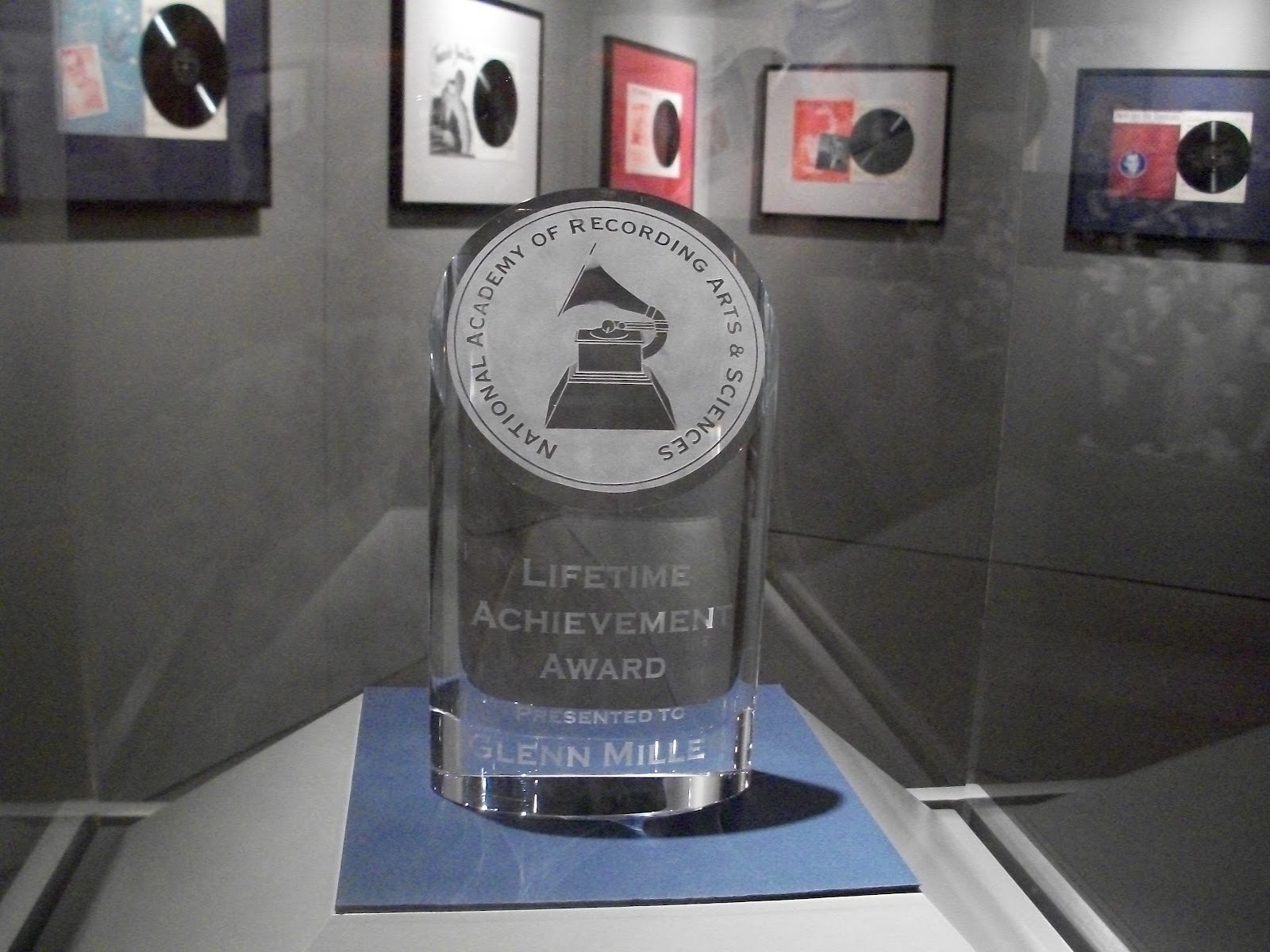
It should be clear by now that I am not opposed to driving waaaay out of my way to visit musical landmarks.  On the way to Lincoln, Nebraska to attend Clarinetfest 2012 (more on that later) I left the Interstate to visit Clarinda, Iowa.  Clarinda is important to Music Zombies because it is the birthplace and home of Big Band Era superstar Glenn Miller.

Clarinda is a small town in the southwest corner of the state.  There isn't much else to see, unless you like farmland, and if you keep driving south for about 15 minutes, you'll end up in Missouri.  When you get into town, that is remarkably unremarkable, watch closely for the small signs directing you to Miller's home.  Once you get close to it though, it's evident that you are in the right place.


This museum is sort of a temporary one.  There is a scale model inside of a new planned museum.

Pennsylvania 6-5000!

One of the band's stand fronts.


The ubiquitous big band anthem.

Awarded posthumously in 2003.


One of Miller's trombones.  The horn only survives today because he didn't have it with him on the  flight to Paris.  He was traveling without the band because he was planning to make preparatory arrangements for a European tour.  The plane disappeared over the English Chanel in December of 1944.

The mouthpiece has Miller's name engraved on it.

His birthplace and home.

Glenn was born March 1, 1904.  Many of the items in the house did not belong to the family (they took their stuff when they moved away from Clarinda) but this calendar is authentic.


His piano, where he did his arranging.  The picture shows him working at it.  The curators have recreated the scene in the shot, down to the blue Wedgwood orb on the right corner and the Chesterfield cigarette on the left.

The front porch.  Cute little house.  Glenn was born in one of the upstairs rooms.  After the Miller's moved away the house was purchased by someone else, who had it completely renovated and remodeled.  Only recently was the house de-remodeled back to its original state, which is what you see now.

Because Miller's body was never recovered, there is no official grave site for him.  There are memorial sites to him, though, and a headstone can be found in Arlington National Cemetery (he had served in the Army).  He was only 40 years old at the time of his death, and the music world lost him much too soon.

Saturday, June 16, 2012

The other waltz king

I met a saxophone this week.  Not a player of saxophone.  The horn itself.  The sax in question belonged to Wayne King, the "Waltz King."  Johannes Strauss, Jr (1825-1899) was, of course, the original Waltz King (there's a post here somewhere about him), but the later King was the bandleader of a notable and successful "sweet" band.  His style has been compared to that of Lawrence Welk, with a soft, dreamy feel.  He was best known for novelty tunes, sentimental songs, and waltzes.

Wayne King's saxophone.  It's a Beuscher.


Wayne King was a Savanna, IL native, near the Quad Cities, and most likely the reason for the horn's visit to Davenport.  He composed some songs, but mostly in collaboration with other writers.  Some better known tunes by King, et. al., include: Goofus, The Waltz You Saved for Me (his band's appropriate theme song), Beautiful Love, and Josephine.  The Wayne King Orchestra recorded with RCA/Victor starting in 1929.  Several albums were released, all featuring the slow, danceable, King style.


Between 1948 and 1952, King even had his own TV show.  It was sponsored by Standard Oil Company, and broadcast over NBC.  The program featured King and his band, and his female vocalist, Nancy Evans, who sang with his band between 1945 and 1983.  He also has a star on the Hollywood Walk of Fame in the Radio category.  King died in July of 1985.

I was certainly fortunate to have been in the right place at the right time to have had the opportunity to see this piece of  big band history.

Wednesday, June 13, 2012

Off the Shelf: The Roots of Swing and Jive

This week's installment of Off the Shelf takes me back in time.  In my high school days, I was a bit obsessed with finding authentic big band sounds, which, sadly, was pathetically difficult in my tiny hometown.  Somewhere, I ran across a couple of compilation discs with tracks of big band standards. These were called The Roots of Swing and Jive: Jungle Swing and The Roots of Swing and Jive: Jumpin' at the Woodside.  I was drawn in by the inclusion of Cab Calloway, one of big band's great showmen and some other recordings of the Duke Ellington and Basie bands.  These were most likely low-budget releases intended to capitalize on the late-1990s swing revival.

Like a baby bird, these were the recordings and sounds that I imprinted with as I began my journey into the tangled jungle of jazz and swing music.  These weren't the first jazz CDs I'd picked up, nor were they the only ones I had to listen to, and the quality of the recordings isn't always great, but the content was exactly what I was looking for.  Even now, I'm always on the hunt for "authentic" and "true" music; my reasoning then and now is: I can learn the most from the greats who set the standard for greatness.  And these bands set the standard high.  At the time, I didn't know who Les Brown was, or the prodigious talent of Artie Shaw, or even how influential Woody Herman was as a musician and bandleader, I just liked the music. 

Starting with the "novelty" tunes, like Herman's Caldonia (who I was stunned to later learn was the singer of this rough and rollicking tune), and Calloway's Jungle Swing (a cute song-story about a monkey and a lion), I then studied the Glenn Miller sound and familiarized myself with Ellington's sax section.  Louis Armstrong was a source of endless fascination: he was so versatile and inventive with his solos.  He had a sound that was instantly recognizable and I dreamed of one day being good enough to have my own sound and being smart enough to get around a set of chord changes without getting too confused.

What probably bears noting is, there is a distinction between "dance" music and "jazz" music, though big band music fits under the grand heading of "Jazz Music".  Embarrassingly, I didn't really understand this distinction completely until about five or six years ago.  Dancers want reliable tempos with strong beats that are easy to dance to.  In the big band heyday of the 1940s, many musicians were employed to play in dance bands.  The Glenn Miller Orchestra was the quintessential dance band of the time; smooth enough, with a bit of a swing, and a high level of musicianship.  Other notable dance bands of this type of swing include Paul Whiteman, Jean Goldkette, Rudy Vallee, and Guy Lombardo.  This style of swing is light on improvisation, and heavy on form and section playing, often using a string section to round out the main band.  Goodman and Herman (among other bands) both helped to push the style from "sweet" dance music to "jazz" music. 

In other words, not all jazz music is danceable.  And some of it isn't meant to be.  (A telling quote from Artie Shaw:  "I made it good enough to listen to.")  This becomes more apparent as jazz music progressed from the big band tradition into bop and fusion.  The music on these two discs is closer to the danceable tradition, and what most people think of when they hear "big band".  The progression wasn't linear, historically; it was concurrent.  True jazz music was on solid ground post-ragtime and dixieland style of the 20s and 30s, but the big band style pushed it all to the front of the stage, so to speak, albeit a bit diluted for the dancing masses.  And electrification would soon bring it all crashing down.

This post could easily turn into several volumes of rambling jazz history, so, for now, I'll leave at this.  The recordings on these two discs are a fair representation of the Golden Age of big band swing.  Not exhaustive, but a  reasonable mix of prime movers in the big band tradition, who retain a significant reputation for setting the standard of greatness.

Saturday, June 2, 2012

Thursday, May 31, 2012

Doodle Doo Doo

Playing in dance bands can lead you down a lot of roads.  Literally and historically.  By "dance band" I mean a big band style band that is employed to provide 1940s era music for people to dance to (You know, dancing.  As a social activity.  That people did for fun before Internet and video games.  And what the really cool people still do now!).  In the literal sense, it is not uncommon to be loaded into a van with the rest of the band and driven all over the surrounding area to get to a small dance hall out in the middle of nowhere.  Historically, and probably much more interestingly, playing in dance bands means that one is introduced to a rich history of other dance bands, large and small, that had traversed the same roads that you may now be traveling (referring again to the literal part).

One name that has continually popped up since I started playing with such bands is that of Tiny Hill.  Not to be confused with Tiny Tim.  Harry Lawrence "Tiny" Hill, was a large, large man (you know how people give inappropriate nicknames because they think it's funny.  On the other hand, calling him "Fatso" may not have been as endearing).  Born July 19, 1906 in Sullivan, IL, he began drumming with a trio while attending Illinois State Normal College.  In 1931, he formed his first big band, eventually gaining enough popularity to tour the Midwest circuit, playing in Nebraska, Iowa, and Missouri.  He used sandpaper blocks and a guiro to create rhythms that made people want to get up and dance.  He and his band were experts at playing happy dance music.

One of the tunes he made popular is one that usually remains stuck in my head for many days after playing it: Doodle Doo Doo is a novelty song, written in 1924, words by Art Kassel and music by Mel Stitzel.  It's a perky little tune, bouncing along: "Please play for me that sweet melody, called Doodle Doo Doo, Doodle Doo Doo!  I like the rest but what I like best is Doodle Doo Doo, Doodle Doo Doo!"  You can easily find a recording on YouTube.  I recommend it; then you'll be singing it all day, too.

Tiny Hill's theme song was another bouncy (some of the best tunes really bounce) song called Angry.  Which now usually reminds me of a certain bird-flinging game.  Other popular Tiny Hill hit was Skirts, Please Don't Talk About Me When I'm Gone, and Dream Girl.

Thursday, May 24, 2012

Call me!

I love big band music.  You know this.  Unfortunately, there are a few tunes are played (and requested) to death.  The anthems, like In the Mood, come to mind.  Another popular song that is oft-requested is Pennsylvania 6-5000.  The song was written by Jerry Gray and Carl Sigman and released in 1940.  The song is a typical fox-trot beat, with opportunities for the band to shout "Pennsylvania six-five-thousand!"

Ever wondered what it means?  I didn't really give it too much thought (there are a lot of songs out there with inconsequential names) until I read about the history of telephones and telephone numbers.  "Pennsylvania 6-5000" is the old telephone exchange system number for the Hotel Pennsylvania in New York City.  Telephone numbers have letters on them, as you will have noticed.  The letters were originally placed there for the call exchange system that was used when telephones first came into normal use.  Under the old system, with the old rotary dials, the first two letters of the address were used as part of the phone number.  P and E are 7 and 3, making the phone number 736-5000.  This system was eventually phased out (sometime around the 1970s) as more locations made the system too complex and the letters are now more of a mnemonic aid.

The phone number became a smash hit because the Glenn Miller Orchestra (and many other big bands of that era) played at the Cafe Rouge Ballroom in the Hotel Pennsylvania, and the phone number was the inspiration for the tune.  There are more lyrics for the song, but the only one that anyone ever seems to know is the refrain, "PENNSYLVANIA 6-5-0-0-0!"

A couple of other phone number songs:   

Beechwood 4-5789 by The Marvelettes (1962)
Jenny (867-5309) by Tommy Tutone (1982)

Not to be confused with calling the operator:  Operator --Mary Wells and Brenda Holloway, written by Smokey Robinson  (1965)

Sunday, January 15, 2012

5 Bits About Benny

Benny Goodman was a big influence on me as a young Music Zombie.  He played clarinet like me!  Well, he played the clarinet a lot better than me, but like me, he played the clarinet.  You know what I mean.  Here are five things about the "King of Swing" that you may not know.

1.  Grew up in the not-so-nice part of Chicago; the ninth of twelve children.  Got his first clarinet lesson at the age of 10 and was getting paid for his playing within two years of picking it up.

2.  He was the first successful band leader to hire (and often defend) black musicians.  This all happened nearly ten years before Jackie Robinson was allowed to play Major League Baseball.  Charlie Christian on guitar, Teddy Wilson on piano, and vibraphone master Lionel Hampton were all hired by Goodman for their virtues as musicians.  In the end, the music was all that mattered to Goodman, and he didn't care what color you were, as long as you could play jazz.

3.  He funded several music conservatory educations and could be very generous, but he never talked about it and had no desire to make these things public.  When asked why he didn't want people to know, he responded that if everyone knew, more people would come to him "with their hands out."

4.  On January 16, 1938, Benny's band became the first real jazz band to play at Carnegie Hall.  With this performance, swing music was introduced to a larger audience and was the beginning of jazz music's acceptance into the mainstream.

5.  So what did he do that was so innovative?  He successfully blended "hot" jazz with the current format of a "sweet" sounding dance band.  Up until his big break at the Palomar Ballroom in Los Angeles in 1935, dance bands were employed to provide relatively sedate music for social dancers.  The current bands swung a bit, but nowhere near as hard as Benny's band, thanks in part to his shrewd taste for top-notch musicians, his clear vision of what he wanted, and his insistence on perfection. 

Bonus: 
 “Listening to Benny talk about the clarinet was like listening to a surgeon get hung up on a scalpel.”
-- Artie Shaw, quoted in the liner notes by Richard M. Sudhalter for the CD “Benny Goodman: The Complete Trios”

Thursday, March 17, 2011

Woody's Thundering Herds

I'm working on a project for a research methods class at grad school.  My chosen topic is to compare and contrast the playing and performance styles of Benny Goodman, Artie Shaw, and Woody Herman.  I know least about Herman, so I've been brushing up my knowledge.

Born Woodrow Charles Thomas Herrmann, May 16, 1913.  Died October 29, 1987.  He was a clarinet player, but got started in big bands as an alto saxophonist.  He was encouraged by an early teacher to learn clarinet as well (YAY FOR DOUBLERS!!)  In 1934 he joined a group led by Isham Jones, reported to be one of the best dance bands in the country.  Eventually Jones gave up the bandleader gig and Woody took over the music.  The first Herd ran from 1936-1946.  A Second, Third and a Swinging Herd followed.

Herman's Thundering Herds remained popular and relevant for many years and Woody continued to play well into his older years.  Some of his most well-known tunes include "At the Woodchopper's Ball", "Four Brothers" (a saxophone feature), and "Apple Honey."

Woody grew up in and around Milwaukee, WI, somewhere I plan to visit for a few days this summer.  I'll have to search for some Herman points of interest.