Showing posts with label red sunglasses. Show all posts

Monday, June 22, 2015

Body and Soul


Six months into my biography project. If you’re new, or just not paying attention, I have decided to dedicate this year to the study of biographies (and autobiographies) or musicians and dancers. Why musicians and dancers? The simplest answer is these are the two topics that have always kept my full attention. Ballet, specifically, fascinates me with its aesthetic, grace, precision, and discipline. The finest dancers possess strength, musicality and astounding control. 

I was fortunate to study ballet while pursuing a dance minor at college. I enjoyed the jazz and modern classes, but always took more ballet classes than was strictly necessary. The feeling of executing a perfect pirouette or moving through an extended adagio combination without losing your balance is absolutely thrilling. I managed to progress enough to try some work en pointe, which is every bit as challenging as it appears to be. After a nearly 10 year lay-off, I have finally returned to a ballet studio. It is so difficult, but I love every minute of it.

At the end of last year I read Apollo’s Angels: A History of Ballet, by Jennifer Homans. This well-researched book chronicles ballet through its beginning in 17th century France, its move through Italy, its subsequent grip on Russia, all before launching itself upon the world. Because so much of the history of ballet is tied to aristocracy and politics, I wound up learning more about European history than I ever did in history class. 

My biographies started with the sublime Dame Margot Fonteyn and has, up to now, taken me through the lives of Maria Tallchief, Jacques D’Amboise, Suzanne Farrell, George Balanchine, and Gelsey Kirkland (whose autobiography I have now read three times). Not surprisingly, they all dance through each others’ books, as they ballet world is rather small. The composers who write through this world include Stravinsky, Tchaikovsky, Chopin, Debussy, among many others.

The musician side of this project is, for better or for worse, heavily weighted in the jazz genre. My jazz foundation began when I was a kid, just starting to notice this thing called jazz. One of my first long reports in school was one of the history of jazz (I also did a report on the history of ballet). I learned about jazz’s beginnings in New Orleans (the history of which is only just now beginning to be clarified) and how it made its way to Chicago and Kansas City and then to New York as it spread itself throughout the nation and the world. Since that initial research, and forevermore, New Orleans has held a special place in my heart as the birthplace of such an intriguing art form. So perhaps it may have been a bit cloying to start the musician side of this project with Terry Teachout’s Pops. Considering Louis Armstrong’s influence on so many musicians since he picked up a horn, it just made sense to me to start the project this way. Following Louis, I have read my way through the lives (and times) of Artie Shaw, Lawrence Welk, Benny Goodman, Charlie Parker, and Woody Herman.

Biographies are brilliant ways to learn history, as no one lives in a vacuum. I have also found them to be a great source of inspiration. The great musicians and dancers are great for a reason. They have talent, certainly, but they also possess ideas, grit, determination, and absolute dedication to their craft. These are qualities that should be acknowledged, admired, and held up as an example of what an individual can accomplish.

Looking forward to the rest of the year, I notice that female musicians are under-represented, so I will be on the lookout for some good women. In the stack of books, though, are the lives of Vaslav Nijinsky, Bob Fosse, Miles Davis, Count Basie, Dizzy Gillespie, the Dorsey brothers, and Lionel Hampton. 

Now if you’ll excuse me, I have some reading to do.

Tuesday, May 27, 2014

Moo

Lest you think I will never post again, here is a picture of a group of musical barnyard friends.


The fellow on the saxophone could really wail.

Sunday, January 12, 2014

Megacolon

Like any good zombie, MusicZombie is undead.  It may hibernate from time to time, run down and tired from lack of good brainy nutrition, but it will always reanimate in search of its food source.  Unless it gets a bullet in its own brain, of course.

So, back again, on a semi-even food-intake level.  This time found in the latest book from one of my favorite authors, Mary Roach.  I have read every book she's written, which include topics about spaceflight to Mars, death, and the physiology of sex.  Her latest is a trip through the alimentary canal (that's the food tube, to those of you who lack dictionaries).  Gulp takes the reader through the digestive system, starting with the nose and saliva and ending at the rectum.  Not topics that may arouse a drowsy MusicZombie...until the entry into the small intestine and colon, where Mrs. Roach explores what really killed Elvis Presley.

It is common knowledge (I think) that Elvis died in the bathroom, apparently straining and causing cardiac arrest.  What is not commonly known is that he possibly suffered from a disorder called Hirschsprung's disease (though without a complete medical history from birth, it may be impossible to know for certain).  Basically, this means that while still in embryonic development (in the womb, again for the dictionary-less among you), the nerve tracks that are being laid throughout the soon-to-be digestive tract fail to develop throughout the entire length of the food tube.  The end of the line is left without the nerves that direct peristalsis (the wave motion that pushes foodstuffs through the intestines).  As a result of this defect, fecal matter gets stuck, so to speak, and gets backed up.  The unfortunate soul with this condition must then rely on sheer mass of stuff coming in to push old stuff to forward.

So, Elvis had to deal with a wicked bout of constipation nearly his entire life.  Drug use, no doubt, complicated the condition.  This actually may help to shed some insight on Elvis's appearance in his later years.  His stretched out, overly packed "megacolon" can be offered for his larger physique, and reports of lackluster concerts.  His autopsy also showed an overly packed, grossly large colon.

And with that, we begin 2014 with MusicZombie!

Monday, July 29, 2013

You read it here first! Probably.

Interview with a Bass Flute

A Music Zombie Exclusive!


Recently, Music Zombie had the chance to meet a Bass Flute.  After some bargaining, and maybe just a little bit of blackmail, the Bass agreed to an interview.  What follows is the transcript of that interview.


Music Zombie:  Thank you so much for agreeing to speak with me.  It's not everyday that I get the chance to meet such an unusual instrument.

Bass Flute:  Well, I am not that unusual.  But I suppose that I don't make as many appearances in bands and orchestras as my higher-pitched relatives.  They like to be heard, I guess.  I prefer to just support the low end of the section.  Occasionally, I will take solos, but because I am hard to hear at times, I often need extra amplification from those nerdy sound-crew people.  And, well, you know how they can be...they're all "Can you move closer to the microphone?"-this and "can you play any louder?"-that.  Sheesh...

MZ:  Still, you make an interesting sound.  You really add something extra to flute choirs.  More depth to the sound, certainly.

BF:  I suppose.  Did you know that I read the same music as C flutes, but the sound I produce is a full octave lower?  Sort of the opposite direction that a piccolo will take.  You know those piccolos like to shriek above the music a full octave higher than the flute.  Haha!  Squeaky little things!

MZ:  Isn't it true, though, that you share some things in common with the piccolo, in terms of construction?

BF:  Well, yes.  Oftentimes, we are made without the extra keys as the foot joint (or completely missing the foot joint, as in the piccolo's case) and I lack trill keys.  I don't suppose folks have any interest in hearing basses trill. 


MZ:  Say, what is the funny foot thing you've got there near your left hand key section?

BF:  My crutch?  Well, I'm glad you noticed! Because my tube is so large, and I am quite a bit heavier than the small flutes, this crutch allows my player a more comfortable hand position.  Here, give it a try.  You will notice that it feels more stable when your left hand has more support.


MZ:  You're right!  That feels pretty comfy!  I did notice that your keys aren't really that much farther apart than on a regular flute, but the hands are more spaced apart. That means that your tube is much longer than a regular flute...but that is to be expected for a low-sounding instrument...care to elaborate?


BF:   Exactly!  Longer tubes equal lower tones.  Again, compare me to the high-sounding, short-tubed piccolo!  However, because my tube is so long, my head joint is usually built with a crook in it.  This brings the hand closer to the player.  This wasn't always the case.  The great instrument designer, Theobald Boehm, made a straight model.  It is reported to have great tone and power, but is really hard to hang on to while playing.  So, most of us nowadays are given curves.


MZ:  Fascinating!  One more thing I couldn't help but notice--your lip plate has a wall on it!  Tell me about that!

BF:  Oh that?  That little wall on my embouchure plate makes me a bit easier to produce a reliable tone.  Because flute players need to create their own back pressure, and I require so much air to play, adding a bit of built in resistance makes me speak better.  What can I say?  I guess I like to play hard-to-get!

MZ:  Well, thank you so much for agreeing to speak with me!  My readers will be delighted to hear what you had to say, and you've certainly taught me a lot!


BF:  You're welcome, I guess.  I guess I'll go back to my case now and take a nap.  Please, no more pictures.

"I SAID NO MORE PICTURES!!"

Friday, December 14, 2012

Drawing

As promised, I learned to use a drawing program.  So, here are two very poorly drawn clarinets.


Tuesday, December 11, 2012

♫ On the 6th day...

...of Christmas, my Zombie gave to me: ♪

6 ft. tall Grace Jones
Ben Folds Fiiiiiiive
4/4 time
3 Pips and Gladys
2 Live Crew
and Tom Waits swinging from a treeeee!

Grace Jones is a Jamaican singer, actress, and model.  As I write this, I'm watching a YouTube video of Jones performing Slave to the Rhythm while hula hooping throughout the entire song.  Impressive. 

She's not actually 6 foot tall, but she's close.  A statuesque and androgynous woman, she's created a following through outrageous outfits, live animals on stage performances, and creative personas.  Jones got her start as a model, then moved into acting and singing.  She appeared in Conan the Destroyer (1984) with Arnold Schwarzenegger and A View to a Kill (James Bond movie #14, 1985), among others.  Jones is a source of inspiration for many artists, including Lady Gaga, as well as for some male celebrities. 

Friday, November 30, 2012

Mmmmm...broccoli...

I just learned that for the last chunk of the third chorus of Michael Jackson's Wanna Be Startin' Somethin' is:

"You're a vegetable, you're a vegetable.
Still they hate you, you're a vegetable.
You're just a buffet, you're a vegetable.
They eat off of you, you're a vegetable."

Wow.

Saturday, November 17, 2012

Humdingers

Several of my oft-visited websites are getting into the Thanksgiving Day spirit (the Thanksgiving holiday in itself is ultimately a slaughter sacrifice of an innocent bird followed by the consumption of way too many calories followed by sitting around on the couch watching an equally non-sensical sporting match all the while trying to tolerate family members you see perhaps twice a year who insist on repeatedly asking you questions like "well why aren't you married yet?").  One site offered not one, but TWO videos of animated turkeys doing something called "dubstep," and also included an MGM cartoon from 1940 called Tom Turkey & his Harmonica Humdingers.  These old cartoons always have the most interesting soundtracks.

This cartoon is about a turkey, let's call him Tom.  Not only is Tom wearing clothes (looking quite snazzy in a green suit and pork-pie hat) he's walking around a settlement run completely by barnyard birds who all, as will be seen, have great skill with musical instruments. I take some issue with this because birds lack lips with which to make a proper seal on a harmonica (or on a whistle, an instrument that pops up later) to produce a good sound, but no one asked me. Okay, so Tom is strolling around playing his harmonica, which I think is a chromatic harp because the music in the cartoon obviously changes keys.  A chromatic harmonica is much larger than a standard diatonic harmonica because there are literally more notes.  Chromatic harmonicas work the same way as a diatonic (that means organized by a scale, in this case a major scale), but they are larger and have a button on one side to shift a mechanism to close off certain holes.  In this way, the player can play in many keys, instead of just one.

Diatonic harmonicas have reeds that are tuned to produce a specific pitch when blown in and drawn out.  In other words, when you blow into a hole on a harmonica one pitch is produced, but when you suck the air back in, the reed produces a different note.

Anyway, Tom is playing his chromatic harp (harp is another term for harmonica) causing a bit of a stir to the other birds, and he wanders into a general store.  It isn't clear whether he knows the manager of this establishment, or even if harmonica playing is generally permitted in the store, but Tom walks (or rather boogies) right in playing a plucky version of Turkey in the Straw, which I think is a bit obvious, not to mention stereotypical, but what do I know about the inter-ornithological social and psychological workings of a town full of birds?  He manages to somehow offend a lady turkey on his way into the store.  It isn't made clear whether he knows the lady turkey or not.

The store is armed with a policebird, who is clearly more interested in shoplifting crackers than protecting the store from unseemly harmonica players.  I am tempted to play the "obvious" card again, but I can't tell for sure if the police bird is a parrot.  If he is, he is not very colorful or vocal, but that may be why he's working security in a quiet agricultural town.

Tom has a seat by the stove, announces his presence and dives into a spirited rendition of Darktown Strutters Ball.  The intro rouses the bird hanging around the storefront, who pulls out his own harmonica and joins right in.  Two birds playing checkers (loitering in a place of business, no doubt) hear the tune and leave their game to add some harmony.  Tom shows off his improvisation skills, then the ensemble collectively push the tempo, and throw in some super choreography.  The ruckus attracts the attention of an elderly gentlebird making his way past the store.  Harmonica music must have restorative properties, because he throws off his cane and ear-horn (the better to hear you with, my dear) and leaps into the store, armed with a whistle.  Entering the fray of harmonicas, the old gent is literally whistling Dixie.  The tune takes over the harmonica-ists (is that right?) and they fall in, marching along to Dixie.

The marching starts to shake apart the building, much like military armies can do if they don't break step while crossing a bridge.  The shop-owner only now shows any concern for the musical chaos that is taking place in his store.  And who could blame him?  His livelihood (and a lot of costly inventory) is about to get the earthquake treatment by a bunch of rowdy chickens!  He implores the policebird for some help, but as before, the policebird is too concerned with eating the inventory instead of protecting it.  Hopefully, his behaviour is reported to his superiors.

Of course, the musicians completely destroy the store (insert musicians destroying hotel rooms joke), with no hindrance from the police bird (insert lazy, donut-eating cop joke).  Out of the wreckage, Tom rises up, calling his fellows back to play.  The music used here is from a tragic opera called Lucia de Lammermoor by Gaetono Donizetti, written in 1835.  The title, Chi Mi Frena in Tal Momento, translates as "what restrains me in such a moment?"  Nothing, apparently.

Segueing into an unapologetic While Strolling Through the Park One Day, Tom moseys away, satisfied with creating such a terrible mess, singing the tune this time (he should stick to the harmonica) when he passes a mannequin in the shop's window.  The mannequin is not birdlike, but a lovely female human figure in a charming purple dress.  Tom grabs the gal and begins dancing to a harmonica band accompaniment. 

The shopkeeper is at his wit's end, trying to get the policebird to do something about all the unruly behavior, when he finally decides to take matters into his own claws.  Storming over to the shop window mannequin-Turkey dance party, the shopkeeper begs Tom to take some responsibility.  I really feel for the guy, he's so upset.  His shop and inventory is ruined, and in this economic climate, that kind of devastation can be really hard to come back from (unless he has some really good insurance coverage).

Walking by the store, again it seems, is the lady turkey that Tom had managed to offend in some way before he did his bull-in-a-china-shop impersonation.  Maybe Lady Turkey is Tom's girlfriend or wife; it's difficult to know for sure because Lady Turkey's character development in this saga is seriously lacking.  Anyway, she notices Tom's shadow dancing with the mannequin's shadow behind the shop window screen and is visibly unhappy about what looks like some disrespectful behavior.

The ruckus had alerted the significant females of the other harmonica-ists (really, is that right? It sounds wrong.) and they all storm into the shop, carrying various forms of benign weaponry (umbrella, rolling pin, frying pan) and take back their men.  As far as I could tell, the guys were really only guilty of property damage, but the gals may be angry because this will now lead to paperwork, visits from insurance people, and claims adjusters, and most likely the police force (if they stop eating crackers long enough to ask questions and make the necessary citations) and, possible, some jail-bird time.

The moral of the story: no harmonicas unless you have really good business insurance and some better-behaved friends.

P.S. humdinger is defined as a person, thing, action, or statement of remarkable excellence or effect. These birds were certainly some effectual humdingers.

Friday, September 21, 2012

I'm going to bum you out now

It was "One hit wonder day" at the local radio station.  It's a classic rock station, so the selections skewed mostly towards hair band and hard rock of the 1980s and 90s, but they also played a few selections from the 1970s.  The music of the 70s is a varied lot.  Much of it is silly (Disco Duck, anyone?), danceable (more disco, sans ducks), wonderfully weird (Hocus Pocus, by Focus!), or ABBA.  At least it was, until punk music came crashing in.

But there are a few songs from that decade that are just depressing.  The Night the Lights Went Out in Georgia (1972), by Bobby Russell (sung by his then-wife Vicki Lawrence) tells a sad story about a sister who kills the cheating wife of her brother, but her brother gets hanged for the crime.  In a way, it's a commentary on the occasional injustice of the justice system.  Another song by David Geddes, called Run Joey Run (1975), tells the tragic tale of a father killing his daughter.  Told from the perspective of the daughter's boyfriend, who had come to her house after she and her father had a fight over what I presume to be a pregnancy by the narrator.  Ah, it's the classic story of girl meets boy, boy impregnates girl, father finds out, father beats up girl, boy tries to come to girl's rescue, but girl takes the bullet intended for boy.

Then, to make you even more depressed, there is the 1975 song by Gordon Lightfoot that describes the sinking and death of all 29 crew of the bulk freighter the Edmund Fitzgerald (The Wreck of the Edmund Fitzgerald).  The freighter went down in bad weather on Lake Superior the night of November 10, 1975.  And, if by now you don't already feel like burying your head in your pillow and sobbing, you can pop in a recording of Don McLean's ode to three freshly dead musicians: American Pie (1971).  The three dead musicians in question were, of course, Buddy Holly, Ritchie Valens, and The Big Bopper.

So, who needs a drink?

Friday, August 17, 2012

Clarinetfest 2012

"Let the clarinet games begin!"

Over the week of August 1-5, I attended the International Clarinet Association's 2012 Clarinetfest in Lincoln, Nebraska.  Clarinetfest is the annual gathering of clarinet professionals, teachers, amateurs and enthusiasts.  It moves around the globe (as it is an international organization); held at different locations each summer.  The Lincoln Clarinetfest was my second one; I'd attended the one in Kansas City, MO about four years ago.

This year's festival was wonderfully diverse and had a good range of lectures and recitals to attend.  The evening concerts alone are worth price of admission, featuring many world-renown clarinetting artists, including bass clarinettist and electronica genius Michael Lowenstern, Klezmer artists Corrado Giuffredi and David Krakauer, and jazz clarinettist Allan Vache, to name a few.

Attendees could attend lectures, demonstrations, and masterclasses, or simply listen to new music from attending recitalists.  I attended a lecture about teaching young beginners music (beyond the clarinet, but also how to integrate it), a masterclass led by Fred Ormand, a couple of Klezmer/Jewish clarinet workshops, and several pedagogy lectures (how to teach, or different traditions and methods of teaching).  The theme of the convention was "Heritage to Horizon", which meant a bit of looking back to several influential teachers within the discipline of clarinet playing and a look forward to what clarinet playing can become, and what the clarinet can do.  With regards to the heritage aspect, some legendary teachers were discussed, including Daniel Bonade, Robert Marcellus, and Kalmen Opperman. 

A panel on the teaching methods and contributions of Robert Marcellus.
Tim Puwalski, demonstrating Klezmer music.  He taught us a tune, by ear, and eventually we were marching around the room, Pied Piper-style, playing a tune.
Allan Vache and his band.  An outstanding evening of jazz music.

It was a great week, overall.  I picked up some new ideas, met up with some old friends and teachers, and have a stack of music and information to start sifting through.  A terrific way to recharge the clarinet batteries!  Now, I must go practice!

Sunday, July 8, 2012

So Damn Lucky

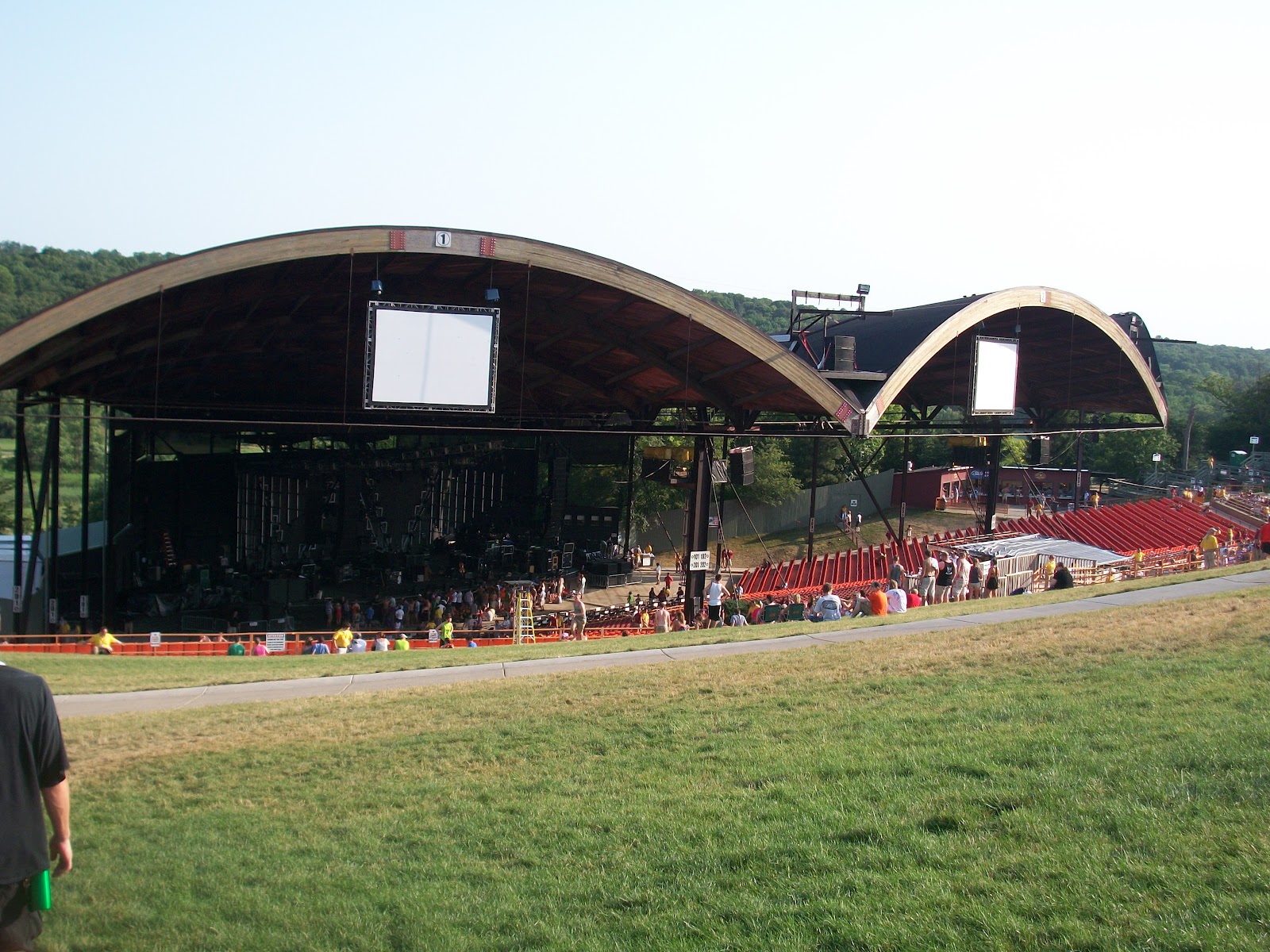
A friend and I made the trip to Alpine Valley in East Troy, WI to see the Dave Matthews Band show on July 6.  The venue allowed cameras this year, so here are some pictures from the concert.  People attend Dave shows for lots of reasons: some go for the party, some go to them because it's tradition to attend one or more concerts every summer, and some go simply for the music. 

Almost there!

YAAAAAY!!!

The venue.  All seats will be filled and the upper lawns will be filled with fans.  Right around 40,000 people.

Somehow managed to get a glimpse of Dave pre-show.  Those are his twin daughters with him.  Their tour buses are behind them.

The Eco-Village had some nifty things, like a couple of these listening stations.

Listening to a track from the new album, due for release in September.


This is Brandi Carlile.  The opening act.  She's really good!  Go buy her music!  She has a Johnny Cash/Sheryl Crow/bluegrass vibe.  Solid vocals, strong guitar/piano work.

Hard working stage crew.  Setting the stage.

Look! Boyd's violin!

He has the best seat in the house.

Stage Left Solidarity.
Stefan Lessard, Rashawn Ross, Jeff Coffin.  Bass, trumpet, saxes, respectively.  Of these three, only Stefan is a founding member, Jeff was brought in after LeRoi's death to cover the sax parts, and Rashawn adds so much to the sound of the band.  Always tasteful, always musical.  The musicianship here is just incredible.

Boyd Tinsley, Tim Reynolds
 It was a hot night.  98-103 degrees.  But the band delivered three hours of solid, non-stop, energized music.  A good mix of old and new songs, including some of my personal favourites.  I try not to go into concerts hoping to hear one song, or expecting them to play certain songs.  They'll play what they want to play.  However, it was great to hear Seven as an opener, The Song That Jane Likes, You Never Know, and All Along the Watchtower.  Closing the show with Tripping Billies was perfect.

Dave, Stefan.


Carter is hidden behind his drum set.  He has a very busy style of playing, but it's never in the way.  Good drummers know how to add to the music without overwhelming it.


A great concert.  Despite the heat, the (very large) crowd seemed to be in good spirits, and the band was appreciative.  It's so great to be a part of something so big and so positive.

Rock on.
 :-)

Thursday, May 17, 2012

Open wide

I've written about my favourite musical already (see the"Feed Me" post).  In honor of a great show, today, if you'll indulge me, I would like to perform a selection from The Little Shop of Horrors.

**Ahem**Ahem**

**haaack!  cough! sputter!!**

CUE THE MUSIC!  *60s style doo-wop, with back up singrrrss!*

When I was younger, just a bad little kid.
My mama noticed funny things that I did.
Like shootin' puppies with a BB gun,
I'd poison guppies, and when I was done.
I'd find a pussy cat and bash in its head!
That's when my mama said:

(Backup singrrrs) What did she say?

She said "My boy, I think someday you'll
find a way
to make your natural tendencies pay
You'll be a dentiiiist!
*smacks bystander in the face*
You have a talent for causing things pain!
Son, be a dentiiiiiiiiist!!
*throws hot coffee at barista*
People will pay you to be inhumane!
Your temperament's wrong for the priesthooood,
and teaching would suit you still less!
Son, be a dentiiiiiiiiist!
You'll be a success!!

*casually trips little old, lady.  HAHAHAHA!*

(Backup gals) Here he is folks, the leader of the plaque!
Watch him suck up that gas!  Oh my God!
He's a dentist and he'll never, ever be any good.
Who wants their teeth done by the Marquis de Sade?

(Hapless, unsuspecting patient, strapped to the chair)  Oh, that hurts!  I'm not numb!

Oh, shut up, open wide!  Here I come!!
*stabs gleefully at patient's teeth*
I'll be your de-entiiiiiiist!
And I enjoy the career that I picked!

I am your de-entiiiiiiist!
*knees patient in the groin*
And I get off on the pain I inflict!

I thrill when I drill a bicuspiiiid!
It's swell, though they tell me I'm mal-ad-justed!
And though it may cause my patients distress
*yanks patient from underneath the desk, plops him back down in the chair*
Somewhere, somewhere in heaven above me
I know, I know that my mama's proud of me!

*dances The Bird down stage right*

Cuz I am a dentiiiiiist!  And a success!

*shimmies back over to patient, holding a large drill*

Say "AH!"

*jazz hands*

Song by Alan Menken 1982

 P.S. No actual puppies, guppies, cats, baristas, little old ladies, bystanders, or dental patients were harmed in the writing of this post.

Monday, May 7, 2012

Superbone!!

I just learned about an instrument called a Superbone.  A Superbone is a hybrid valve and slide trombone.  It has the traditional slide mechanism of normal trombones, plus the valve mechanism like a trumpet.  I've heard of valve trombones, but those trombones are more like big, low trumpets.

The TR 395 Superbone was developed in the 1970s by the Holton company in collaboration with jazz monster-trumpeter Maynard Ferguson, and other companies made similar instruments.  It wasn't the first of its kind though.  A "Valide" trombone (valve + slide) was invented by jazz trombonist Brad Gowans, who played one with from the 1920s through the 1950s, even while with the Jimmy Dorsey band.  Duke Ellington's trombonist, Juan Tizol, used a valve/slide hybrid bone after joining Ellington's band in 1929.

What makes the Superbone unique from the previous designs is its fully functional, 7-position slide, the three-valve mechanism positioned alongside, and a slide lock.  The valves are gripped with the left hand, supporting the instrument and leaving the right hand free to operate the slide.

On a related note, there is also something called a Firebird, also developed by Ferguson.  The Firebird the trumpet counterpart to the Superbone.  It is a trumpet (valves and all) with up to a 4-position slide mechanism.  The valves can be gripped by either the right or the left hand, leaving the other hand free to operate the slide.  On some models, the bell is bent upward at a 20 degree angle to allow room to move the slide.

The brass world is even weirder than we thought.   ;-)

Thursday, March 1, 2012

Story Time

Today, I want to tell you a story.  Not a particularly good or funny story, but a story.  Have a seat, feel free to eat a snack or have some tea.

Many years ago, I had the good fortune to play with a music group that toured Iowa.  I was in the jazz band part of this group, playing second chair alto saxophone and clarinet.  After spending the majority of the summer playing in tiny towns, and slightly larger towns, and sometimes big towns, all over Iowa; staying in Iowan homes with nice Iowan families (ask me about the "shower is in the basement" home-stay.  Yikes!)  I learned a lot about what is involved with schlepping around a three hour show, including set pieces, instruments, PA gear, sound equipment, about 45 high-school aged kids, plus band leaders,a charter bus, and a 50-foot Ryder truck.

The final stop for this tour was a two-week stay-and-play at the Iowa State Fair.  I was introduced to the wonderfulness of the Tubadour, saw the bands Sugar Ray, Fastball, and Def Leppard at the Grandstand, and between shows, rehearsals, and enjoying the fair stuff, practicing my clarinet because I was going to start college immediately after the Fair ended.

Just before the Fair opened, our group was supposed to act as Grand Marshals of the pre-Fair parade.  So, they loaded us up onto trams that took us from the Fairgrounds to the parade route.  The skies began to get grey and dark...

We arrived at the Capitol building, and had to wait for rain.  A lot of rain.  Fortunately, we were allowed to stay on the trams until the weather cleared enough to allow the parade to begin.  Being naive high school students, and at the end of our tour, we were in fairly good spirits, and so took the rain in stride.  Once the officials were okay with starting the parade, we were loaded up onto a flat-bed semi-truck trailer (fortunately, we didn't have to play or sing or dance on that thing) and paraded through the parade.  Fine.

After reaching the end of the parade route, we were unceremoniously kicked off of the flat-bed trailer and told to wait for the trams to pick us up to take us back to the Fairgrounds.  The trams did not show up.  It was still a bit overcast, though the rain had stopped.  So, we walked around a bit, following our fearless leaders as they seemingly wandered around Des Moines, searching for our missing trams.  At one point, one of our directors decided to leave the group, apparently determined to find the trams himself.  The other directors stuck around, to keep us in line, and not lost, I guess.  May I remind you that this was before the proliferation of cell phones? 

It's beginning to get late, and still no trams.  Our director returns to where we had been waiting for him and says, in that ominous tone that tells you that you are going to have to do something that you really aren't going to like: "This is going to be an adventure!"  He turned and began walking.  We followed him.  His solution was to have us walk the several miles back to the Fairgrounds.  This resulted in 45 kids, in khakis and polo shirts, wandering around the not-very-nice part of Des Moines. 

We were nearly to the Grounds, when the trams appear! Where the hell were they nearly an hour ago when we were still soggy from the rain, cold, tired, and hungry post-parade?  We were told that they were being used to ferry the Fair Queens back to wherever it is that Fair Queens come from, and the musicians were neglected.  (I know.  Typical, right?)  We got back on our trams, and rode the remaining half-mile back to our Fair dorms. 

And with that, we kicked off our two-week stint at the Iowa State Fair. 

Wednesday, February 1, 2012

Ephemera

There really is a condition called amusia.  It means that the individual's brain can hear music, but it can not comprehend it.  In other words, the listener can't distinguish music from non-music.  It's all just noise to them.

Astronaut Neil Armstrong played the euphonium.  He even marched with the Purdue All-American Marching Band.  In space, though, no one can hear you play.

Frederic Chopin is buried in Pere Lachaise cemetary in France.  His heart, however, was removed from his body and buried in Poland.  This was done at the composer's request.

Elvis Presley's manager (Col. Tom Parker) also managed a group of dancing chickens.  Do you think that's where the King learned his dance moves?

The U.S. has more country music radio stations than any other type of music station.  I feel conflicted about this.

Thursday, January 12, 2012

Driving around in cars

Driving around town this morning, trying to get through the first snowfall of the winter season without banging up my car too badly, I heard a song on the radio that I've never particularly liked, but as I'm usually dialed to a classic rock station (when not listening to a CD), I hear a lot.  I started thinking how Pink Cadillac, by Bruce Springsteen (I even thought someone else did this song, not the Boss), is really a very silly song.  I was paying attention to the lyrics because focusing on music helps me concentrate while driving.  Weird, yes, but it seems to work for me.  I get some of my best thinking done in the car.

ANYWAY.

Pink Cadillac by Bruce Springsteen.  Originally, I wanted to write an open letter telling him how silly and illogical he's being.  I mean, in several lines he says how annoying his girl is to be around, and then he says that he has money so it isn't that she's rich or anything like that (which means he can buy his own Cadillac-in whatever colour he wants- and can therefore get away from the annoying woman).  No, he loves her for her "pink Cadillac."  Which I learned, upon further research, was originally a veiled reference to a unique part of the female anatomy.  Hmmmm. 

You'll never hear this song again in quite the same way.  In fact, through this lens, I can't even read the last verse without losing my brain to the gutter.  Well, there you go. 

Thursday, December 15, 2011

Variation 6

Heavy metal suicides Music outside of the "mainstream" is typically regarded with wariness.  Especially when the music is heavy, hard, loud, and makes full use of the right to freedom of speech and expression (i.e.offensive language).  In other words, if the music isn't pleasant and positive, it is targeted for being a "bad" influence on its listeners and performers.  While this may be true in some isolated cases, it has been my experience that heavy metal music is simply another genre of the long list of musical styles.  Most of the performers and fans of metal music that I've encountered have at first given me an impression of hardness or cruelty, but in talking to them, I've realized that they are just normal people who happen to like their music to have a certain edge.  I like jazz music, but that doesn't make me a brainless coke-fiend (I have no good reason for using stereotypes from the 1960s).

Of course, there are isolated cases.  Such as the case in 1985 where two families sued the metal band Judas Priest.  Their claim was that the music of Judas Priest drove two young men to kill themselves after listening to the band's music.  For me, this brings up an interesting question, not unlike the question that Rob Gordon asks in the movie High Fidelity.  "Did I listen to pop music because I was miserable? Or was I miserable because I listened to pop music?"  In my case: Am I  neurotic because I am a woodwind player?  Or am I a woodwind player because I'm neurotic?  The whole chicken vs. egg thing.

So, does metal music make people behave violently or have an adverse reaction (how's that for a euphemism?), or are people who are predisposed to this kind of behaviour attracted to metal music?  Just as many violent things happen to (and are caused by) people who listen to other kinds of music. 


What do you think?

Saturday, December 10, 2011

Variation 5

Punk rock is a form of popular music that developed in the U.S., the U.K. and Australia between 1974 and 1976.  It is characterized by fast, short songs, minimal instrumentation (think a guitar or two, a bass, and drums), and lyrics that often proclaim dissent on establishment and government.  In the U.S. the three most influential punk rock bands were The Ramones, The Clash, and the Sex Pistols. 

Punk evolved a bit into the 1980s, becoming even faster and more aggressive.  The original punk rock movement influenced other bands that emulated, or were clearly inspired by, the earlier punk bands.  These bands include Green Day and The Offspring, two bands who were eventually accepted into the mainstream, and in the case of Green Day, is still popular and relevant today.  Ironic, no?

"In its initial form, a lot of [1960s] stuff was innovative and exciting. Unfortunately, what happens is that people who could not hold a candle to the likes of Hendrix started noodling away. Soon you had endless solos that went nowhere. By 1973, I knew that what was needed was some pure, stripped down, no bullshit rock 'n' roll." --Tommy Ramone

Friday, December 2, 2011

Waldstein madness

The Theme and Variations has been temporarily suspended, due to some struggling with Beethoven's Piano Sonata,  No. 21, Opus 53, the "Waldstein".  Named for and dedicated to Count Ferdinand Ernst Gabril von Waldstein of Vienna, Austria in 1803 (he was a patron and friend of Beethoven's).  I'm in the throes of trying analyze this monster.  I chose it for my paper because I like how it sounds, but now I'm kind of wishing I'd chosen an earlier, simpler sonata.  Oh, well. 

I think you may have heard this famous sonata opening in a car commercial within the last couple of years and in the opening sequence of the HOUSE episode guest starring Dave Matthews (YAY!).  The opening driving eighth-notes of the Waldstein is the sonata that Dave's character is playing before his brain starts to blow up.  And then he becomes the Patient of the Week.  Dave's character, not Beethoven.  Though Beethoven may have benefited from some medical diagnostic assistance from Dr. House...poor Ludwig.  His health was never very good throughout his life, then he went deaf. 

Music Zombie will return shortly with the concluding Variations.  BTW, if you haven't figured out where the Theme and Variations are derived from, you just aren't paying attention. 

Cheers!  :-)

Tuesday, November 1, 2011

Make it stop!

Barney the Dinosaur's I Love You, song has been used by the U. S. in Guantanomo Bay's military detention camp to get information from the detainees.  Other songs used as torture devices:

The Real Slim Shady --Eminem

Enter Sandman --Metallica

We Are the Champions --Queen

Killing in the Name --Rage Against the Machine

Shoot to Thrill --AC/DC

Drrty --Christina Aguilera

Sesame Street opening theme song

The Meow Mix commercial theme song.  Meow, meow, meow, meow, meow, meow, meow, meow! Meow, meow, meow, meow, meow, meow, meow, meow!! 

Sorry to get these tunes stuck in your head.  Please come back.

> : )

*Source: Mental_floss magazine, Nov-Dec 2011, Vol 10, Issue 6