It was "One hit wonder day" at the local radio station. It's a classic rock station, so the selections skewed mostly towards hair band and hard rock of the 1980s and 90s, but they also played a few selections from the 1970s. The music of the 70s is a varied lot. Much of it is silly (Disco Duck, anyone?), danceable (more disco, sans ducks), wonderfully weird (Hocus Pocus, by Focus!), or ABBA. At least it was, until punk music came crashing in.
But there are a few songs from that decade that are just depressing. The Night the Lights Went Out in Georgia (1972), by Bobby Russell (sung by his then-wife Vicki Lawrence) tells a sad story about a sister who kills the cheating wife of her brother, but her brother gets hanged for the crime. In a way, it's a commentary on the occasional injustice of the justice system. Another song by David Geddes, called Run Joey Run (1975), tells the tragic tale of a father killing his daughter. Told from the perspective of the daughter's boyfriend, who had come to her house after she and her father had a fight over what I presume to be a pregnancy by the narrator. Ah, it's the classic story of girl meets boy, boy impregnates girl, father finds out, father beats up girl, boy tries to come to girl's rescue, but girl takes the bullet intended for boy.
Then, to make you even more depressed, there is the 1975 song by Gordon Lightfoot that describes the sinking and death of all 29 crew of the bulk freighter the Edmund Fitzgerald (The Wreck of the Edmund Fitzgerald). The freighter went down in bad weather on Lake Superior the night of November 10, 1975. And, if by now you don't already feel like burying your head in your pillow and sobbing, you can pop in a recording of Don McLean's ode to three freshly dead musicians: American Pie (1971). The three dead musicians in question were, of course, Buddy Holly, Ritchie Valens, and The Big Bopper.
So, who needs a drink?
Friday, September 21, 2012

Monday, September 17, 2012
These keys are made for sharping
I keep thinking about something a bassoon teacher once said: keys are on (woodwind) instruments to raise a pitch, not to lower it.
Think about that for a moment.
I don't mean the pads or levers that close and cover the tone holes, as they are clearly meant to lower the pitch of the tube (sequentially cover all of the tone holes on a clarinet, and the pitch goes down); long tubes make lower pitches. Basic physics kind of stuff.
But the keys that don't cover the main tone holes are where they are to allow the player to play all of those chromatic notes that the basic instrument could not play if it only had the tone holes. For example: the Eb key on the right hand side of a clarinet (and operated by the right hand first finger) is used to raise the already fingered note D one half step. We refer to the key as an Eb (E flat) key, but in reality, it is raising the D to a D# (D sharp).
It's the same story an octave up (still on a clarinet) to the Eb/D# key on the right hand (operated by the right hand pinkie finger). To play the note, the clarinetist must cover the tone holes for D, they open the Eb key to raise the pitch by one half step: to D#.
This is profoundly simple, but I think it isn't recognized right away because we often refer to those keys in their enharmonic flat names. There are a few anomalies, like the G# keys on saxophones and flutes, but their half-step-raising-D mechanisms are still usually referred to as Eb keys.
Wednesday, September 12, 2012
Off the Shelf: Bob Dylan
Sorry for the hiatus. My non-blogging life got a bit out of hand. But I'm back with a long overdue Off the Shelf installment: Bob Dylan (told you it was a chewy one).
I randomly selected from Ye Olde CD Shelfe The Best of Bob Dylan, a disc I picked up while going through a mild Bob Dylan phase (actually I picked up at least 3 Dylan discs during that time). I've touched on the genius of Dylan already; very briefly in one of the Billy Joel/We Didn't Start the Fire variations, but I think I can give you a bit more.
The Best of disc features many of the greatest hits (as you would expect from something with "best of" in the title) from Dylan over the course of his career. The liner notes are quick to tell us that it's impossible to put all of Dylan's greatest songs onto one single disc, which is true, but this one is still a good representation his work, starting with Blowin' in the Wind, passing through All Along the Watchtower, and briefly into his more recent work.
Dylan made waves with a stream-of-consciousness, politically charged, confessional style of folk music. One the songs that really caught my attention was Hurricane, co-written with Jacques Levy in 1975. The song describes, in true folk-song narration, the accusation, trial, and imprisonment of boxer Rubin "Hurricane" Carter, who was a friend of Dylan. Carter was accused of robbery and murder, in accomplice with two other accused men. The initial trial gave him a guilty sentence, but Dylan, among other supporters, felt that the trial was racially charged, and so, in protest to what he felt was an unfair trial and sentence, wrote the song. He was forced to re-record it to avoid potential lawsuits concerning the details about the actions of the other two men in the trial. The song eventually stirred things up enough to get Carter a second trial. In 1988, all charges against Carter were dropped.
I couldn't help but notice how many Dylan songs end up as hit cover songs by other artists. Watchtower has been covered countless times, from the "definitive" cover by Jimi Hendrix to my favourite cover by the Dave Matthews Band. Knockin' on Heaven's Door was covered most notably by Eric Clapton, but also by Guns N' Roses, Booker T and Ladysmith Black Mambazo. Blowin' in the Wind was made a hit by Peter, Paul & Mary (not to mention all the renditions sung around campfires, by church groups, and by protesters protesting anything.)
Truthfully, this entry will not be as complete as I'd like it to be. The story of Bob Dylan is just too big for me to take in right now. But I'll keep turning it over in my brain, like a rolling stone.
Sunday, September 2, 2012
Team Elphaba
I have finally gotten around to reading Wicked: The Life and Times of the Wicked Witch of the West. As usual, I'm about 6 years (more or less) behind the trend. The book is a "parallel novel", written by Gregory Maguire, that tells the story about the events in the land of Oz, from the point of the view of the Wicked Witch of the West. It uses many references from the Baum books and from the 1939 film.
In the L. Frank Baum novels, the Witch isn't given much development, beyond being the antagonist of the story, chasing Dorothy or terrorizing the civilians of Ozland. In fact, she isn't even given a name. In Maguire's telling of the times of the Witch, she is given the name Elphaba (a phonetic derivation of L. Frank Baum's initials), and one is led to reconsider what it means to be "wicked" or "good." Is being wicked really an absolute quality, or do circumstances and outside forces play a larger role? If anything, the reader is led to be more sympathetic to the Wicked Witch of the West. I'm certainly looking at the storyline of the film a little differently now. Anyway, the 1995 book was reworked into a Broadway musical.
Wicked: The Untold Story of the Witches of Oz, (book written by Winnie Holzman, and music lyrics by Stephen Schwartz) changes several details from the book, but remains a convoluted story about the friendship between Elphaba, the Wicked Witch of the West, and Glinda, the Good Witch of the North. The book explains how both characters become what they become, in a really elegant way, actually.
Stephen Schwartz has composed many acclaimed musicals. He wrote the music for Godspell, Pippin (one of my favourite musicals and one he started writing music for while still in college), Children of Eden, and The Magic Show. He is one of only four composers to have a three musicals run over 1000 performances on Broadway (Wicked, Pippin, and The Magic Show). The other 3 composers are Andrew Lloyd Weber, Jerry Herman, and Richard Rodgers.
You can also hear his work in movies. He collaborated with Alan Menken to write songs for Disney's Pocahontas and The Hunchback of Notre Dame, and wrote music for The Prince of Egypt. Again with Menken, he wrote lyrics for Disney's Enchanted, resulting in 3 songs from that production earning nominations from the Academy Award for Best Original Song.
Schwartz certainly defies gravity.
Wednesday, August 22, 2012
Look Hugh's Talking, 2

I've blogged about The Hugh Laurie before (check out the post called "Let Hugh Talk"), and I've told you how incredibly fascinating and obscenely talented the man is. Well, I had the very fortunate fortune of seeing him perform in person.
If you've read that post, you know that Laurie is an accomplished musician (and an actor, novelist, comedian, and all around smart person), and earlier this year he released a blues album. The concert I attended featured Hugh and the fantastic Copper Bottom Band. It was a sold out show at the Englert Theatre in Iowa City.

Laurie is a natural showman, ready with a joke or wry comment, and equally adept on piano, guitar, or shot of whiskey. I was, admittedly, a bit star-struck at being so close to someone I truly admire. The Englert is a small theatre, in turns a movie theatre and live theatre, and I had a great seat (I could see that he was wearing a plastic, green watch). The show was sold out and the audience was very appreciative, though I wondered how many people were there just because Hugh is a TV star, and if they even knew that he was a blues musician.
 |
| The man himself. :-) |
The musicians played many songs from his album Let Them Talk, and several more. The band did a great job of staying within the blues style, which is a big deal for me. It's sometimes discouraging to hear otherwise wonderful players try to play more than the music asks of them. He had the typical rhythm lineup, with a bass, drums, and guitar, plus an organ/accordianist and a man that Hugh introduced as "the master of all things blowy,"a reed player who played all saxes, clarinet, and harmonica. At one point, he was even playing two saxes at once. That takes talent!
Along the way, he gave the audience interesting tidbits of information about the songs and the blues musicians who wrote them, so I can count this as an educational concert, too. The band also took a brief break to enjoy a bit of whiskey. While we watched. Funny stuff.
It was one of the most enjoyable, non-DMB concerts I've ever attended. What a great show!
Friday, August 17, 2012
Clarinetfest 2012
"Let the clarinet games begin!"
Over the week of August 1-5, I attended the International Clarinet Association's 2012 Clarinetfest in Lincoln, Nebraska. Clarinetfest is the annual gathering of clarinet professionals, teachers, amateurs and enthusiasts. It moves around the globe (as it is an international organization); held at different locations each summer. The Lincoln Clarinetfest was my second one; I'd attended the one in Kansas City, MO about four years ago.
This year's festival was wonderfully diverse and had a good range of lectures and recitals to attend. The evening concerts alone are worth price of admission, featuring many world-renown clarinetting artists, including bass clarinettist and electronica genius Michael Lowenstern, Klezmer artists Corrado Giuffredi and David Krakauer, and jazz clarinettist Allan Vache, to name a few.
Attendees could attend lectures, demonstrations, and masterclasses, or simply listen to new music from attending recitalists. I attended a lecture about teaching young beginners music (beyond the clarinet, but also how to integrate it), a masterclass led by Fred Ormand, a couple of Klezmer/Jewish clarinet workshops, and several pedagogy lectures (how to teach, or different traditions and methods of teaching). The theme of the convention was "Heritage to Horizon", which meant a bit of looking back to several influential teachers within the discipline of clarinet playing and a look forward to what clarinet playing can become, and what the clarinet can do. With regards to the heritage aspect, some legendary teachers were discussed, including Daniel Bonade, Robert Marcellus, and Kalmen Opperman.
 |
| A panel on the teaching methods and contributions of Robert Marcellus. |
 |
| Tim Puwalski, demonstrating Klezmer music. He taught us a tune, by ear, and eventually we were marching around the room, Pied Piper-style, playing a tune. |
 | ||
| Allan Vache and his band. An outstanding evening of jazz music. |
It was a great week, overall. I picked up some new ideas, met up with some old friends and teachers, and have a stack of music and information to start sifting through. A terrific way to recharge the clarinet batteries! Now, I must go practice!
Saturday, August 4, 2012
In the Mood
It should be clear by now that I am not opposed to driving waaaay out of my way to visit musical landmarks. On the way to Lincoln, Nebraska to attend Clarinetfest 2012 (more on that later) I left the Interstate to visit Clarinda, Iowa. Clarinda is important to Music Zombies because it is the birthplace and home of Big Band Era superstar Glenn Miller.
Clarinda is a small town in the southwest corner of the state. There isn't much else to see, unless you like farmland, and if you keep driving south for about 15 minutes, you'll end up in Missouri. When you get into town, that is remarkably unremarkable, watch closely for the small signs directing you to Miller's home. Once you get close to it though, it's evident that you are in the right place.

One of Miller's trombones. The horn only survives today because he
didn't have it with him on the flight to Paris. He was traveling
without the band because he was planning to make preparatory arrangements for a European tour. The plane disappeared over the English Chanel in December of 1944.


The front porch. Cute little house. Glenn was born in one of the upstairs rooms. After the Miller's moved away the house was purchased by someone else, who had it completely renovated and remodeled. Only recently was the house de-remodeled back to its original state, which is what you see now.
Because Miller's body was never recovered, there is no official grave site for him. There are memorial sites to him, though, and a headstone can be found in Arlington National Cemetery (he had served in the Army). He was only 40 years old at the time of his death, and the music world lost him much too soon.
Clarinda is a small town in the southwest corner of the state. There isn't much else to see, unless you like farmland, and if you keep driving south for about 15 minutes, you'll end up in Missouri. When you get into town, that is remarkably unremarkable, watch closely for the small signs directing you to Miller's home. Once you get close to it though, it's evident that you are in the right place.

 |
| This museum is sort of a temporary one. There is a scale model inside of a new planned museum. |
 |
| Pennsylvania 6-5000! |
 |
| One of the band's stand fronts. |
 |
 |
| The ubiquitous big band anthem. |
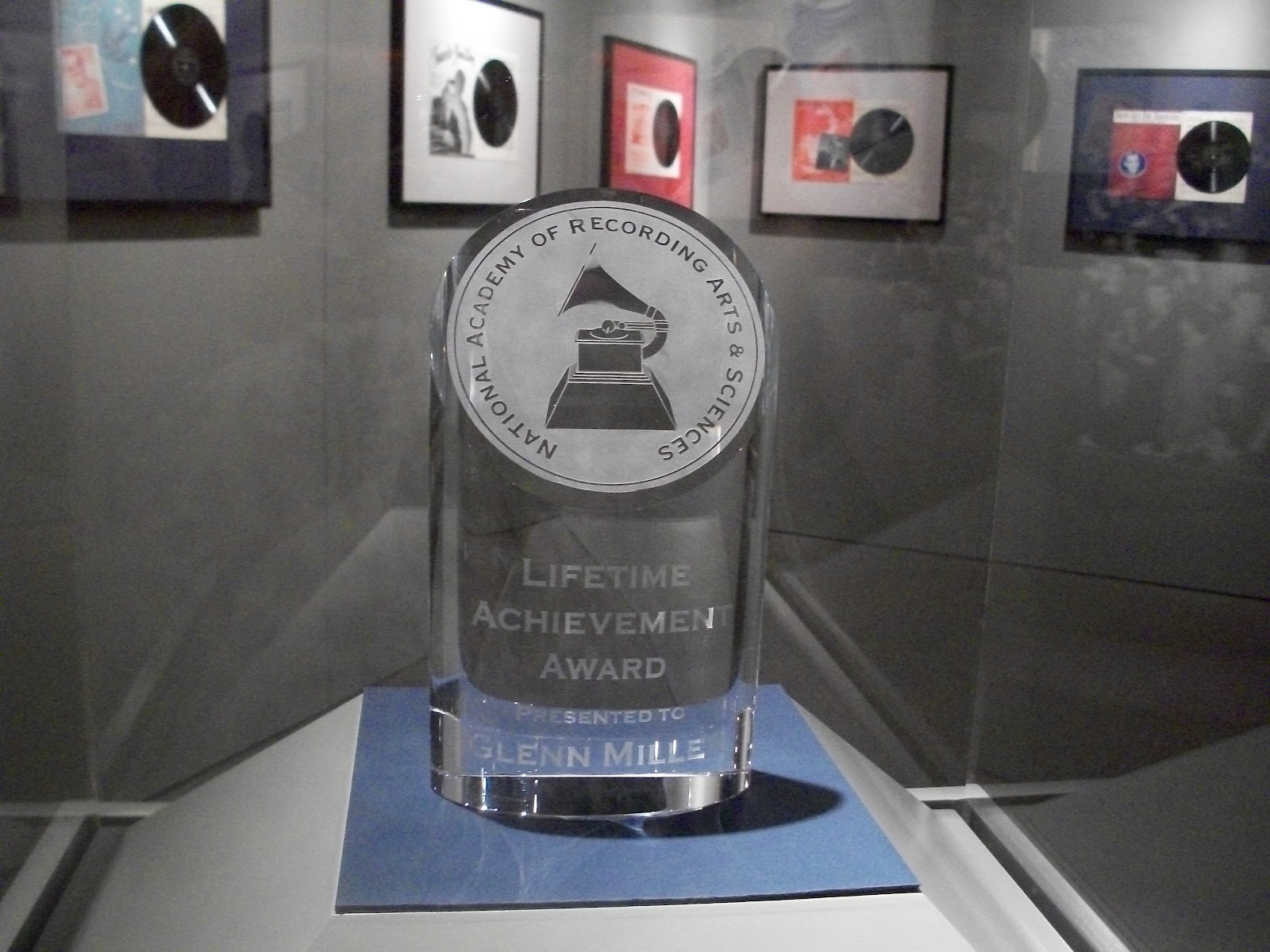 |
| Awarded posthumously in 2003. |
 | ||||||
 |
| The mouthpiece has Miller's name engraved on it. |
 |
| His birthplace and home. |
 |
| Glenn was born March 1, 1904. Many of the items in the house did not belong to the family (they took their stuff when they moved away from Clarinda) but this calendar is authentic. |

His piano, where he did his arranging. The picture shows him working at it. The curators have recreated the scene in the shot, down to the blue Wedgwood orb on the right corner and the Chesterfield cigarette on the left.

The front porch. Cute little house. Glenn was born in one of the upstairs rooms. After the Miller's moved away the house was purchased by someone else, who had it completely renovated and remodeled. Only recently was the house de-remodeled back to its original state, which is what you see now.
Because Miller's body was never recovered, there is no official grave site for him. There are memorial sites to him, though, and a headstone can be found in Arlington National Cemetery (he had served in the Army). He was only 40 years old at the time of his death, and the music world lost him much too soon.
Subscribe to:
Posts (Atom)